Wednesday, July 31, 2013

Frisch's Top 5 Favorite 2D Platformers

With DuckTales: Remastered on the horizon, I thought now was the perfect time to think about some of my other favorite 2D side-scrolling platformers.  So, behold:  My Top 5 Favorite 2D Platformers!  Woo!

5. Commander Keen: Marooned on Mars (MS-DOS)


The first game in the Commander Keen series released in the early 90s for MS-DOS, Marooned on Mars sees eight year old Billy Blaze fly to Mars in the Bean-With-Bacon Megarocket only to lose some key parts of his ship on arrival.  Donning a Green Bay Packers football helmet and the name Commander Keen, it's up to Billy to track down his missing ship parts so he can get home.  This was the first computer game to successfully replicate the side-scrolling gameplay of the Mario series and, while later Keen games became significantly more detailed and advanced, the charming simplicity of the original just can't be topped.  Marooned on Mars was released as freeware, and it's still readily available should you want to give it a go via DOSBox.

4. Cave Story (Just about everything, but I favor the 3DS version)


Another freeware title, Cave Story follows the adventure of Quote, a mute robot, as he explores a mysterious cavernous island and watches as a surprisingly tragic turn of events unfolds there.  Cave Story is not a new game, so at this point there isn't really much I can say about it that hasn't been said already.  Between it's rock solid gameplay, excellent soundtrack, and its moody atmosphere, it's very hard to dislike Cave Story.  It's available on a number of consoles these days, but you can still pick up the freeware version.  And, I can't recommend it enough if you haven't played it already!

3. Donkey Kong Country Returns 3D (3DS, also Wii)


DK's return on the Wii was great fun, but it was the return of his return on the 3DS that cemented this platformer's place on the list.  An impressive game already in its original home console iteration, the nearly uncompromised jump to the handheld resulted in one of the meatiest and most visually impressive games in the 3DS's library.  Add in New Mode to tone down the frustration factor, and you've got yourself a bona fide masterpiece.

2. Shantae (GBC, 3DS VC)


WayForward's oft overlooked GameBoy Color adventure starring a half-genie who whips her hair at bad-guys recently got a release on the 3DS's virtual console, allowing it to be widely available for the first time.  And thank goodness for that!  A sidescrolling platformer with the structure of a Zelda game, Shantae oozes personality.  From it's incredibly detailed animations to it's memorable locations, insanely catchy music, cleverly designed dungeons, and it's tongue-in-cheek sense of humor, Shantae is good fun the whole way through.  Make no mistake, the game is seriously challenging and can get a little frustrating at times, but it's always worth it to push through and figure out what to do next.

1. Kirby's Adventure (NES, Wii & Wii U VC, 3D Classic on 3DS)


Kirby's Adventure is just fun.  Everything about it is fun.  It has fun gamplay.  It has fun levels.  It has fun music.  It has fun graphics.  It's just fun.  And that sense of fun is infectious.  Of course, outside of its irresistible charm, Kirby's Adventure is also an incredibly well designed game.  The level designs are extremely inventive and varied and finding all the secrets sprinkled throughout the game's world is a considerable challenge.  But, most of all, Kirby's Adventure is a game that just puts you in a good mood when you play it.  And, really, isn't that the whole point of video games; to enjoy yourself?


Also...not a single Mario game on the list.  Surprise!

Sunday, July 28, 2013

Toy Review: Spin Master Sulley vs. Bandai Sulley

Several weeks ago I wrote an article lamenting the lack of decent looking toys of Sulley, the big blue monster that everyone loves from Pixar's Monsters Inc. and Monsters University.  Though that article largely focused on plush toys, the ugly-Sulley curse has not just been limited to plush toys alone.  It also has impacted the vast majority of Sulley action figures over the years.

In my quest to acquire a toy that truly captured Sulley's likeness I ended up importing an action figure from Japan that I thought did a good job.  I also acquired the equivalent figure that's widely available throughout the US.  Which Sulley will come out on top?  There's only one way to find out!  Let's have at it!

Spin Master's Scare Student Sulley vs. Bandai's Monster Student Sulley.
Our two contestants today are Scare Student Sulley, the US version created by Spin Master, and Monster Student Sulley, the Japanese equivalent created by Bandai.  The two are priced very similarly, around ten dollars depending on the retailer, but Bandai Sulley is a bit larger.  He checks in at about six and a half inches tall while Spin Master Sulley is about five inches tall.  Spin Master Sulley is made form a hard solid plastic, while Bandai Sulley is made from soft vinyl.

Sculpt Quality:


Both versions of Sulley are at least clearly recognizable as the same character.  That said, the Bandai version has the definite edge here.  The fur texture is much more noticeable and defined versus the Spin Master version.  Having molded fur overlap the joints between Bandai Sulley's neck, legs, and wrists definitely helps to give him a nice shaggy appearance.  Spin Master Sulley is much more subdued, having a smoother overall appearance.  That said, Spin Master Sulley preserves the slightly longer fur that Sulley has around his shoulders while Bandai Sulley does not.  Overall, though, the look of Bandai Sulley's sculpt is much more effective.

Winner:  Bandai Sulley


Paint Application:


When it comes to paint, both figures have some noteworthy pros and cons.  Bandai Sulley as a whole is a little bit calmer when it comes to colors, being just a touch more green-tinted than Spin Master Sulley.  Most of Bandai's Sulley's paint appears to be applied via airbrush, which creates nice soft edges for details like his spots and the lighter fur on his belly.  The downside to this approach, however, is that some of the paint application looks little sloppy, causing the colors bleed onto other parts of figure.  Sulley's claws are also only painted on one side, leaving them blue on the opposite side.  His spikes, horns, and eyes are all painted with more precision.


Spin Master Sulley's paint is noticeably brighter and bolder  His paint is much more precise, with all the details having hard edges.  This works fine for his claws and face, but looks a bit odd on his spots and belly as the edges are so crisp and defined.  There are also some imperfections in the paint job on his back.


It's hard to judge which figure does a better job here.  On the plus side, Spin Master Sulley has considerably more spots than Bandai Sulley, though he has no spots on his head.  Bandai Sulley has one small spot on his cowlick, similar to the movie.  And, while the airbrush look does lead to some imperfections, it does create a better furry effect for the spots and belly.

Winner:  Bandai Sulley


Likeness:

This the category where Spin Master Sulley really falls short.  When it comes to which toy looks more like Sulley, there's almost no comparison.


Spin Master Sulley has the look of a Happy Meal toy.  You can tell what character he's supposed to be, but there's just something a little off about all of his proportions, especially his legs.  His pose is also rather stiff and he's much more hunchbacked than the Bandai version.  His face is rather lifeless, primarily because of his eyes.  His irises are a bit too large for the size of his eyeballs, and they aren't quite looking in the same direction, giving him a rather dead expression.  He's showing off his teeth, at least.


Bandai Sulley knocks it out of the park when it comes to matching the look of the character from the film.  His overall posture is noticeably more relaxed and his proportions are much more authentic.  Sulley's face has a sense of warmth and liveliness to it.  Though his mouth is closed, it conveys a lot of personality.  It's the eyes that really make the difference here, though.  With better shaped brows and smaller irises, Bandai Sulley looks just like the movie.

Winner:  Bandai Sulley


Articulation:


Spin Master Sulley runs away with this category.  His articulation is primarily limited to his arms, but it's quite good, with his shoulders being able to rotate and move in and out, as well as having the same kind of articulation at the elbows.  This means it's possible to put his arms in a variety of positions, even up like he's about to scare someone.  His tail and head can also rotate, but given the design of the figure, they look best when left alone.

Bandai Sulley really doesn't do a whole lot.  His arms rotate at the shoulder, but with no other articulation in the elbows or anything like that, it's hard to pose his arms in way that doesn't look stiff and unnatural.  They pretty much have to be left at his sides.  His head rotates similar to Spin Master Sulley, but his tail does not.  His legs actually rotate as well, but due to how they connect to the body, they really don't move that much.  As a whole, Bandai Sulley is pretty much stuck in his default position.

Winner:  Spin Master Sulley


Overall:

In the end, the obvious winner is Bandai's Monster Student Sulley, available in Japan.  Though a little cheaper in a few aspects, Bandai Sulley is head and shoulders above Spin Master's rendition in almost every way.  The sculpt in notably more detailed and the paint job looks a bit nicer as well.  Spin Master Sulley has the advantage when it comes to articulation, but Bandai Sulley takes the cake when it comes to the overall likeness. There is no question which figure looks more like the character as we see him in the movie.  If you want to have Sulley on your shelf, Bandai Sulley is the way to go.


Bandai's Monster Student Sulley can be ordered online here.
Spin Master's Scare Student Sulley can be ordered online here.


Monday, July 8, 2013

Movie Review: Despicable Me 2


2010's Despicable Me turned out to be a surprise hit.  Despite featuring an incredibly predictable plot about a super villain learning to be a father, the film managed to win audiences over with it's snappy pacing, irresistible sincerity, and clever slapstick humor.  Yes, you knew where the plot was going from the very first scene, but Gru was such an easy character to root for that you were glad when everything worked out in the end.  A thoroughly enjoyable animated family film.

Sequel time!


In Despicable Me 2, we learn that Gru, still Steve Carell donning his signature ethnically ambiguous accent, has turned away from his villainous ways to focus on being a better father to his three adopted daughters Margo, Edith and Agnes.  Of course, Gru's legions of little yellow unintelligible Minions are still around too, but with the days of evil scheming behind them, they are now employed to help Gru develop his own jam and jelly company, a business venture that is not going real well.  Soon, Gru is recruited, somewhat forcefully, to assist the Anti Villain League in tracking down a new super villain threatening the world.  To assist him, Gru is partnered with ditzy secret agent and potential love-interest Lucy, voiced by Kristin Wiig in a manner nearly identical to her role as Lola Bunny on The Looney Tunes Show.

And then a drawn out slapstick set-piece occurs that doesn't really advance the plot too much.   And then there's another one.  And then another one.  And another one.  And another one.  And then the movie ends, concluding with a somewhat shameless plug for The Minion Movie, coming next year.

Despicable Me 2's biggest shortcoming is definitely its plot.  In that it barely has one.  Oh sure, all of the makings for a plot are here.  Gru's fear of women and dating is established early in the film.  Agnes is longing to have a mother.  Margot is becoming interested in boys.  Gru's partnership with the Anti Villain League becomes strained when his suspicions about who the villain might be appear to be unfounded.  And so on.  There are lots of plot points introduced, but none of them ever have a chance to develop.  Instead, after being set up, they just disappear entirely to make way for another string of episodic mishaps until they suddenly get resolved at the end of the film.  There's no character development or running narrative to get invested in here.  The film tries to end in an emotional manner recalling the original, but there's just no substance to back it up this time.


Instead we get scene after scene of Gru trying to accomplish something, somehow messing it up, and then dealing with the hilarity that ensues.  And, admittedly, when this film is funny it's really funny.  Just as funny, if not more so, than its predecessor.  Despite trying to be a good guy, Gru's more sinister side still rears its head from time to time, often with hilarious results.  The Minions are also much more prominently featured this time around, and while they get some good laughs early in the film, they quickly overstay their welcome.  Toward the third act of the movie, the focus of the film shifts almost completely to being about the Minions and it's at this point that their comedic charms wear off and they start to grate on the nerves.  I still fail to see how Universal expects these characters to carry and entire film of their own next year.

Additionally, the cleverness and wit of the writers must have only been able to extend so far, because Despicable Me 2 often resorts to pulling out the standard gross-out gags that so many children's films resort to these days.  There are fart jokes a plenty this time around, along with a nice helping of other assorted potty humor, cheap laughs, and even a touch of Minion nudity thrown in for good measure.  (Since we all wanted to see that, right?)  Without the emotional core that kept the original Despicable Me going, Despicable Me 2 just feels hollow and empty, as the comedy value can only sustain the film for so long.


It's a real shame too, because all the seeds for a story just as solid and heartfelt as the original are here, but the movie never takes the time to flesh them out.  Agnes' desire to have a mother in particular really could have been developed into a great emotional core for the film, but it's only touched upon in two brief scenes and really just feels like an afterthought.  Instead, most of the screen time is devoted to jokes that go on for far too long.  Despite clocking in a reasonably brisk 95 minutes, this film's pacing drags terribly.  Most of the slapstick set-pieces seem to go on for ages, making even the funnier moments of the movie start to fall flat.  One particularly uncomfortable bit featuring a woman who has been knocked out with a tranquilizer dart goes on far longer than it ever needed to.

Too much time is spent dwelling on jokes that have already ended instead of fleshing out the story and characters.  Even the film's climax fails because, despite being a brilliantly animated spectacle, it carries no weight since there's no plot to get invested in.  The villain's dastardly scheme is cryptically revealed throughout the movie, but once it's fully explained it never goes anywhere, so there is never a sense of urgency or risk.

Ultimately, Despicable Me 2 is just another mediocre run-of-the-mill sequel.  It's colorful, action-packed, and has more than enough fart jokes to keep the kids giggling all the way through.  And if that's all you're looking for, you won't be disappointed.  But if you're hoping for another heartfelt story that follows up on the charming tale told in the original Despicable Me, you're not going to find it here, as Despicable Me 2's story is woefully underdeveloped and hollow, despite teasing the audience with what could have been an excellent narrative.  And that's just despicable.

Sunday, July 7, 2013

What happened to the Mario series?


A couple weeks ago Nintendo revealed Super Mario 3D World, the latest entry in the Mario series for the Wii U.  And the response was subdued, to say the least.  Some people were excited, but most seemed to greet the game with a collective yawn.  And some were straight up upset about the reveal.  I can count myself as one of the many who found the game to be a bit underwhelming.  But why?  After all, 3D World looks to contain all the hallmarks of the series that have made it so enjoyable over the years, and even brings back the character roster from Super Mario Bros. 2, Princess Peach included.  By all means, Super Mario 3D World looks like another excellent title for the series.  And yet, it just wasn't met with the kind of excitement that has been the norm for new Mario series reveals.

That the Mario series, despite not suffering from any significant drop in quality, has lost its appeal for so many gamers is the result of two key problems that I have identified.  Either problem on its own would cause the series to become stale, but the fact that the Mario series is suffering from both of them together has accelerated the process significantly.  Each issue exacerbates the other, which has resulted in the Mario series quickly falling from grace in the eyes of many longtime fans and turning what was once Nintendo's most beloved franchise into one of its most hated.  I'm going to examine each issue separately below and then explain how together they have soured so many fans' excitement about the series.  Let's begin, shall we?

Main Series Mario games are becoming too common: 


First, let's take a look at a timeline of when all the main series Mario games were released.  This is just kind of a general overview, excluding some oddities like The Lost Levels and Yoshi's Island:

1985 - NES - Super Mario Bros.
1988 - NES - Super Mario Bros. 2
1990 - NES - Super Mario Bros. 3
1991 - SNES - Super Mario World
1996 - N64 - Super Mario 64
2002 - GCN - Super Mario Sunshine
2006 - NDS - New Super Mario Bros.
2007 - Wii - Super Mario Galaxy
2009 - Wii - New Super Mario Bros. Wii
2010 - Wii - Super Mario Galaxy 2
2011 - 3DS - Super Mario 3D Land
2012 - 3DS - New Super Mario Bros. 2
2012 - Wii U - New Super Mario Bros. U
2013 - Wii U - Super Mario 3D World

In a series that spans almost thirty years total, half of the games have been released in the last seven years, with 2008 being the only year since 2006 not to have a main series release.  Why is that?  There are two main reasons, that I can tell.  First, the series now has to serve double duty, as Nintendo handheld consoles have advanced to the point that ports of old games and small scale spin-offs like Super Mario Land are no longer enough to get the job done.  Since the Nintendo 3DS can handle games just as good as what the home consoles deliver, the main Mario series is now serving as the lead system-seller for both Nintendo's home consoles and their handheld consoles, resulting in many more Mario games much more frequently.

In the olden days, this would have still been the most recent Mario game.

Furthermore, after New Super Mario Bros. turned out to be a monster hit on the DS, the main Mario series splintered into two facets:  the 2D side-scrolling "New" series and the 3D games that continue the legacy of titles like Super Mario 64, Sunshine, and Galaxy.  It has now become a tradition for all Nintendo consoles to host not one major Mario title, but two, with every console receiving at least one New Super game and at least one 3D game.  The Wii even got two 3D Mario games.  With the 3DS and the Wii U releasing within only a couple of years of each other, the result is four main series Mario games in three years.  Heck, NSMB2 and NSMBU were released within only a few months of each other.  Gone are the days of having to wait for six years between major Mario titles.  Now they're a dime a dozen.  There is never a time now when a new major Mario game is not on the horizon.

But, of course, that's also how the Mario series began.  The first four main series Mario games were also released in rapid succession of each other, with three of them even being on the same console, and World showing up before Super Mario Bros. 3 even had a chance to get comfortable.  And yet, all those games were considered classics of their time and remain among the most revered video games ever created.  What's different now that makes the Mario series appear to stagnate so much compared to back then?

Back then games were smaller and cheaper to create.  A major triple-A title didn't require an enormous team of developers and a huge budget to create, which also meant they could be created faster.  Furthermore, the staples of the Mario series had yet to be established, so all four of these games were still inventing the elements that remain the cornerstones of what the franchise is today.  Despite being released with only a year or two separating them, the first four Mario games were all radically different from each other, with their own visual styles, gameplay styles, power-ups, and more.  They all brought something very new to the table.

It took three sequels for the first screen of the game to change enough to actually feel like something new.  Also, was that arrow sign at the beginning of the first level of NSMBWii really necessary?

These days it's not so simple.  Games cost a lot more to create and it takes a lot longer to polish them up to perfection for today's significantly more advanced technology.  Back when consoles would play host to only one Mario game instead of several, there would often be a five or six year wait between them, not because Nintendo wasn't working on something that whole time, but because it simply just took that long to develop something new.  Now that Mario games need to be released much more quickly, the same teams of people are continuously jumping from one game to the next.  The team that made Super Mario Galaxy then jumped immediately into Galaxy 2, then 3D Land, and then 3D World.

Because there is little downtime between the games to develop brand new ideas, most of the innovations brought to the table with each successive game are relatively small in scope, meaning that the overall experience between the games is very similar.  Without having the time to create something truly revolutionary with each new Mario game, the series has sort of settled into a formula that most games, both 2D and 3D alike, follow now.  Following the first Galaxy game, the Mario series began to feel very standardized, with a lot of gameplay elements, power-ups, and ideas being shared between both the New Super games and the 3D series.  A new Mario game these days is more about refining what the previous games did instead of doing something entirely new because there simply isn't enough time for every game in the series to do that anymore.

3D World looks less like a sequel to 3D Land, and more like a home console counterpart, similar to a game like Sonic Lost World.  It feels more like having two versions of the same game instead of two distinct games.

The same phenomenon also began impacting the Mario Kart series once it became a staple for both handhelds and home consoles.  There was a four year wait between Super Mario Kart and Mario Kart 64.  There was a five year wait between Mario Kart 64 and Mario Kart Super Circuit for the GBA.  However, it was only two years later when the series showed up on the GameCube in the form of Mario Kart Double Dash!!.  All of these games were significantly different from each other, each having their own unique look and feel that made them all seem distinct from one another.  However, starting with Double Dash, new entries in the series have become much more common, with games showing up in 2005, 2008, and 2011, with the latest set for early next year.  As the result, the overall look and feel of the Mario Kart series has become much more standardized, with Mario Kart 8 not looking all that distinct when compared to Mario Kart 7, Mario Kart Wii, or even Mario Kart DS, especially considering that all three of those games remain readily available in stores today.

Nintendo prides themselves on creating titles that are "evergreen."  That means that their games are able to consistently sell lots of copies years after their initial release.  The problem that arises, however, is that if a previous installment of a series is continuing to sell and remains fresh in consumers' minds five or six years after being released, a new entry has to be an obvious step up from the previous game or it won't feel like it's truly a worthy successor to what is already available.  When it's only been a year or two instead of half a decade, it's even more critical that a new installment really prove that it's worth playing even if you've already played the previous games.  Even if a new game is extremely good, why would you want to spend the money to get it when you already have a similar game in the same series that provides the same kind of experience?  Sequels, especially frequent sequels, must prove that they will provide fresh new experiences that previous games can't deliver or consumers will start to lose interest.

And, frankly, the Mario series just isn't cutting the mustard anymore.  Because all the games in the main series have become so homogenous, with few significant advances between titles, it's extremely difficult to get excited about playing another Mario game that appears to be so similar to the last Mario game, let alone the last four or five Mario games.  Which leads me into the second issue that is plaguing the modern Mario series...

New Super-itis:


The term "New Super-itis" is one of my own invention.  I've tossed it around before on this blog in various articles about the Mario series, but I've never really explained quite what I meant by it before now.  In 2006, Nintendo hit upon a gold mine.  A massive gold mine.  That year, Nintendo released New Super Mario Bros. for the Nintendo DS.  Not only did this mark the first time that an original full-scale main series Mario title was being released for a handheld console, it was also the first new 2D side-scrolling Mario game released in nearly fifteen years.  As such, the game played like a trip down memory lane.  The worlds consisted of nice familiar themes already seen in previous games: a grassland, a desert, a beach, a forest, and so on.  The game also stuck very closely to the formula of Super Mario Bros. 3, a game often cited as the best in the series.  There were some new elements introduced that had never been in a Mario side-scroller before, but many of them were simply elements from previous games brought back in a bigger way, like Mega Mario.  The game was comfortable, safe, familiar, and marked a major turning point in the series.

It was at this point that Nintendo discovered that simple and safe Mario games that relied on the legacy of the series sold better than the bold new games that took the series in different directions.  They discovered that there was a huge audience out there for side-scrolling Mario games that eschewed the complexity and openness of the 3D titles for basic obstacle courses and nostalgic level gimmicks.  And that audience would become known as the infamous group known as "casual gamers," a term that can refer to anyone anywhere in the range between "only plays games from time to time" to "complete idiots who don't know how to perform the simplest of tasks."  Or, at least, that's how Nintendo seems to see it based on their modern approach to the Mario series.  It's the same gigantic audience that made the Wii a success, buying up consoles in droves to play Wii Sports, Wii Fit, and the like.  In an era where Nintendo had lost most of its relevance in the video gaming industry as a whole, they found their new niche via casual gaming.

Who knew this game would have such an impact on the series as a whole?

 New Super Mario Bros. got the ball rolling, but it was New Super Mario Bros. Wii in 2009 that cemented the fate of the Mario series.  That game sold like nobody's business.  To date it has sold nearly thirty million copies worldwide, an astronomically high number by any standards.  Compare that to the eleven million or so copies that Super Mario Galaxy has sold to date and it quickly becomes clear which type of Mario game is the preferred choice of Nintendo's new audience.  And it sent a very clear message to Nintendo:  Mario games don't need to be groundbreaking innovative adventures to sell well.  They just need to be easy for anyone to play.  The graphics don't matter.  The music doesn't matter.  All that matters is that any person, no matter how young or old, no matter how much or little gaming experience, no matter how smart or dumb, could pick it up and finish the game.

And thus, the Mario series came down with a serious case of "New Super-itis," a complete restructuring of the entire series to conform to the mold of New Super Mario Bros. Wii in the hopes that all Mario games could now sell the ludicrously high number of copies that NSMBWii did.  And the way to do that, it seems, is to assume that your audience is made up of people who don't even know how to turn on a Wii, let alone understand any concepts of gameplay.  3D Mario games like Super Mario 64 and Super Mario Sunshine were suddenly labeled as being "too confusing" for new players.  Open level design could no longer be a part of the series because players could "get lost."  Linear levels were the only way to ensure that players could enjoy themselves.  Features like the "Super Guide," which let the game effectively play itself, became standard for the series, and extra lives were handed out like they're going out of style, making the Game Over screen a rare sight indeed. 

When Super Mario Galaxy 2 was released, a series of "How To" videos accompanied it.  In the US they were (and still are) available to watch on the website, but in other regions of the world they were actually packaged with the game on a DVD.  So, just in case the concept of plugging a nunchuk controller into a Wii remote is too much for you, you can pull out your handy DVD and watch a tutorial.  I wish I was being sarcastic, but that's actually covered in the first video.  Nintendo began designing Mario games to appeal to the lowest common denominator.  A denominator that was assumed to be so low that they might not even understand the very most basic aspects of playing a video game.

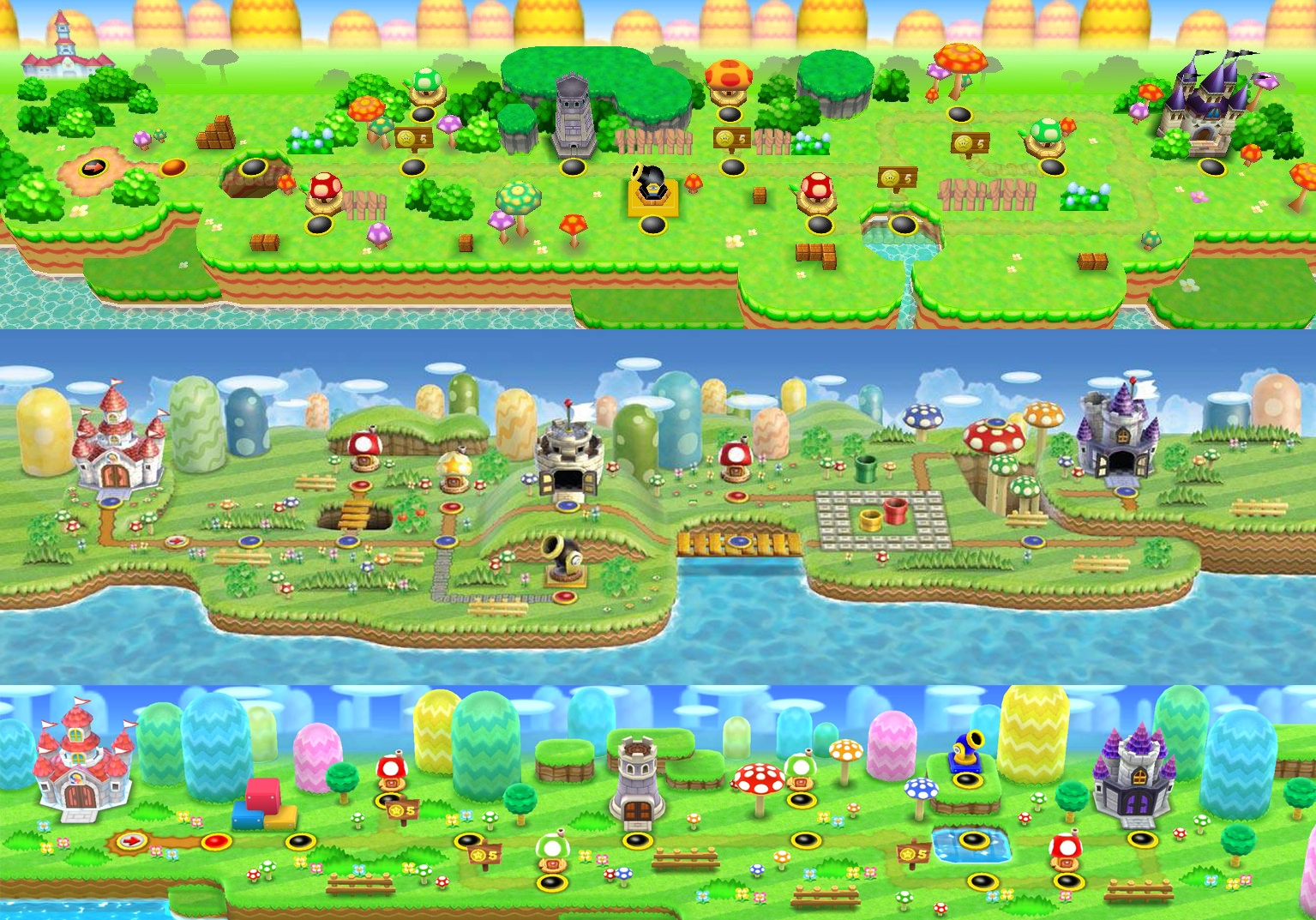
Which World 1 is which?  And why does Peach's castle keep losing details?

The other far more detrimental result of "New Super-itis" is that it was apparently determined that all new Mario games should also look like New Super Mario Bros. Wii.  That way, even the most uninformed consumer could look at a game, recognize the scenery, and decide to buy it because it reminded them of NSMBWii.  Suddenly the generic plastic worlds of the first two NSMB games became the only worlds to appear in every Mario game, main series and spin-offs alike.  Since the NSMB games relied on looking to the past of the series for ideas, suddenly all Mario games became focused on delivering up nostalgic re-imaginings of elements from previous games.  "New" features weren't really new anymore.  Instead, they were old features given a new coat of paint, like the Tanooki tail.  Nostalgic enough to keep old fans interested, but familiar enough and simple enough to not upset the balance of entertaining any possible person who might pick up a Mario game.  Complexity was out and patronizing simplicity was, and still is, in.

Three other Mario games that have come down with a case of New Super-itis.

The result?  Mario games have become forgettable.  They are still fun.  They are still incredibly well designed and polished.  They still have flashes of the brilliance that made the series what it is today.  But they no longer have a sense of identity.  There is no longer a sense of scope.  No sense of discovery.  No sense of surprise.  No sense of challenge.  When Mario games do offer up legitimately new ideas these days, they are usually reduced to little more than basic gimmicks for one level which are fun while they last but leave little in the way of a lasting impression.

There isn't necessarily anything wrong with Mario games like this.  Pick up and play any given main series Mario title and I guarantee you will enjoy yourself.  They are essentially the gaming equivalent of comfort food.  But it means that every game in the series is now very homogenous and nothing really stands out anymore.  Super Mario 3D World looks like a good game, but it also looks incredibly similar to 3D Land, NSMB, Galaxy 2, and all the other main series Mario games from the last few years.  The moment it was revealed, I felt like I had played it already.

Okay, Frisch.  Get to the point:


So, in the end, it basically boils down to this:  The Mario series is tired.  The quality of the series hasn't declined, but there's nothing fresh about the series anymore.  The limited scope of the gameplay lacks impact, the standardized look of the series has become overly familiar, and the increased number of releases over the last six or seven years means that we've all just seen it all too many times to get excited about it again.  New features from game to game tend to be small improvements and minor gimmicks and the standardized graphics and design ensure that even while experiencing something new, most new Mario games feel incredibly familiar.

The solution?  Mario just need a vacation.  The 3DS has its two main series games now.  Once 3D World is out, the Wii U will have its two games as well.  At that point, the quota for current-gen console Mario games will be met.  It's time for a break.  It's time to let some other Nintendo franchises step up to the plate and carry the torch for the next five or six years.  Then, when the next console generation is upon us, Mario will be rested, reinvigorated, and ready to lead the charge once more.

Furthermore, when the Mario series does make its return, the New Super series and the 3D series need to be given separate identities once more.  Compare New Super Mario Bros. Wii and Super Mario Galaxy.  They are two entirely different games, both extensions of different aspects of the Mario series, and both with a unique audience.  If the main series is to remain split into two ongoing lines of games, there's no reason not to let the 3D games have large open worlds again, a larger scope, and cater to more experienced gamers, as the 2D games have the more casual audience covered.  That way everyone can have what they want.

Is that what Nintendo will do?  Unfortunately, I doubt it.  And, by all means, if they don't I do not think the Mario series will be ruined.  He'll still be a dependable hero for good solid platforming antics.  But the sense of excitement and anticipation for each new Mario title will continue to diminish and would be a shame to see such an extraordinary series be reduced to simply an ordinary and unexciting one.

Just my two cents on the matter.  Now, if you'll excuse me, I'm off to pre-order a copy of Super Mario 3D World...

Sunday, June 30, 2013

Re-Ranking the 14 Pixar Films

Allow yourself to be transported to roughly a year ago.  Way back then, I posted a list ranking the 13 Pixar films that had been released up to that point.  Well, here we are a year later, with a new Pixar film to add to the list.  But rather than just stick it into the existing list, I've reevaluated all my opinions about each film, so there might be a few surprises in store if you're expecting all the other films to still all be in the same order!

14. Cars 2


Cars 2 easily manages to retain its spot at the bottom of the list.  Last year I still tried to defend the film somewhat but, let's be honest here.  Cars 2 is a bad film.  Its story is not very interesting, it's characters are flat, and the fact that the film has almost no heart combined with some surprisingly dark scenes just give the entire film an unpleasant after-taste.  It's very much watchable, but the argument that "even the worst Pixar film is better than all other animated films" is definitely not the case here.  Sorry, Michael Caine...

13. Brave


I was still trying to like Brave when I wrote last year's list.  But I just can't like it.  It's a gorgeous film for sure, but that's really the only thing it has going for it.  To date, this is the only Pixar film that I don't own in my DVD/Blu-Ray collection.  It's also the first Pixar film in years that I only saw once in theaters.  It's story is just too contrived and uninteresting for me to want to revisit it.  I didn't hate it the first time I watched it, but I have almost no desire to watch it again.  So, in the end, Brave isn't really bad.  It's just very very forgettable.  Perhaps another pass at the script could have fine-tuned it into something special, but the film that was released just wasn't quite there yet.

12. The Incredibles


Brave's bump down means that The Incredibles gets to stay in the #12 spot for another year.  Once again, there isn't really anything wrong with this movie.  It's a really well put together movie.  I've just never been able to understand the appeal of it.  It's very solid, but it's style just doesn't grab me, so I hardly ever feel like revisiting it.  On the plus side, Brad Bird's audio commentary on the DVD is one of the finest tracks to accompany an animated film, so I at least have to give it credit for that.

11. Cars


I still like Cars.  I still don't love Cars.  I still think it's a bit too long for the story its trying to tell, and could have been a stronger film with some brisker pacing.  But, as a whole, it's likable and easy to enjoy.  Not one of Pixar's masterpieces, but certainly not deserving of the amount of hate that gets heaped upon it, sometimes seemingly just because of how poor its sequel is.

10. A Bug's Life


I really want to rate A Bug's Life higher than the #10 spot.  I just watched it again recently and it's so good.  Really, if you haven't watched A Bug's Life recently, give it another look.  It's likable, funny, and has an incredibly good story.  It's also home to one of Randy Newman's best film scores.  But, unfortunately, A Bug's Life just doesn't have any particular elements that I really latch onto the way most other Pixar films do.  No particular characters I really love.  No particular scenes I really remember above the rest.  It's still an extremely good film, though, and a fantastic example how charming Pixar films can be.

9. Monsters University


Pixar's latest film manages to find a nice comfortable spot here in the middle of the list.  It's very much like A Bug's Life in that it doesn't necessarily stand out in any major ways, but it's constantly enjoyable and fun throughout.  The biggest advantage it has over Bug's Life is its memorable cast, headed up by the always easy-to-root-for Mike Wazowski and James P. Sullivan.  Throw in a really great and realistic message for audiences, and you have a nice solid prequel.

8. Up


I used to like Up a lot more than I do now, and I still find it to be an incredibly moving film.  These days, however, I've started to lean toward the opinion that the more fantastical elements of the movie just aren't quite as compelling as the grounded-in-reality story of Carl and Ellie.  It's still a thoroughly enjoyable film, and it never fails to make me cry, but during some of the more action-oriented sequences I find myself looking at my watch a bit, hoping to get to the next quite emotional scene, as they are really the main reason I enjoy the film.

7. Toy Story 3


Whoa!  What happened here?  My #2 pick from last year dropped all the way to #7?  What's that about?  Well, after watching all the Toy Story films again in the recent past, I can't help but feel like Toy Story 3 maybe just went a little too serious for its own good.  It's still a great film, and all of the praise I gave it last year still applies to it today.  But now, looking back, it does feel like a rather jarring transition to go from the incredibly funny Toy Story 1 and 2 to the more muted and melancholy Toy Story 3.  A good way to end the series, sure, but not really the most fun film to go back to and just watch on its own.  I find there are a few other Pixar movies that I tend to be more interested in revisiting over this one these days.

6. Ratatouille


The film about the little chef that could has definitely grown in my eyes a bit since last year.  I'd still argue that it has some pacing problems and that the story could have been tightened up in a few places but, by and large, it's hard to imagine the film working better than it does right now.  The visuals are beautiful, the music sublime, and every single character is interesting and easy to invest in.  From Remy's almost fanatical passion about what he does to Chef Skinner's increasing paranoia about ghost rats to Anton Ego's delightfully dark but sophisticated way of carrying himself, all the characters leave a lasting impression here.  Ratatouille is definitely unlike other Pixar films, but I mean that in the best possible way!

5. Monsters Inc.


There you go, Monsters Inc.!  You made it into the Top 5!  I lamented not having a higher spot on the list for this film last year and thanks to some of the reshuffling, Monsters Inc. has managed to get it's moment to shine.  As I mentioned earlier in this list, Mike and Sulley make for an incredibly entertaining and endearing duo to watch and they consistently steal the spotlight from one another throughout the adventure.  Add in a supporting cast of creative monsters, and a solid emotional core to the story courtesy of Boo, and you have one of the finest examples of Pixar providing the whole package of technology, humor, and heart that they so often pride themselves on.

4. Finding Nemo


Nemo finds himself moving up one spot this year thanks to Toy Story 3's fall from grace.  In addition to being one of the most universally appealing Pixar films to any audience, Finding Nemo is also one of the most beautiful.  In fact, having watched last year's 3D re-release in theaters,  I was still blown away by how good this film looks, despite having watched it dozens of times prior to that.  The undersea world of Nemo and his friends is wondrous to behold.  Getting to spend an hour and a half in this world accompanied by Pixar's best comedic duo, Marlin and Dory, is a real treat.  As resistant as I was to the thought of a sequel at first, I can't deny that I am looking forward to visiting this world again when Finding Dory rolls around in a couple years!

3. Toy Story


It's a real testament to the quality of Toy Story that it can continue to be as entertaining today as it ever has been, despite it's notably dated visuals and 90's culture.  The characters are wonderful, the story is fresh and original, the music memorable, and the moving van chase scene at the end still provides one of the most exhilarating and entertaining climaxes to be scene in a Pixar film.  Toy Story has a timeless quality that will no doubt make it a classic for generations to come.

2. Toy Story 2


Toy Story 2 takes everything that Toy Story did and does it one better.  More wonderful characters, an even more interesting and fleshed out story, more memorable music, and a much more developed emotional center to back up all the humor.  Rex gets his time in the spotlight for much of this film, completely upstaging his traveling companions at every turn and newcomer Jessie's tragic backstory that parallels what Woody is dealing with is heartfelt and brilliantly executed.  Toy Story 2 introduces many of the more somber themes that dominated Toy Story 3, but here they are kept relatively subdued so they never get in the way of the humor or drag the movie down.  The perfect balance of humor and heart.

1. WALL-E


Surprising nobody, WALL-E manages to hang onto the top spot.  Everyone's favorite little robot is just as easy to root for now as he was last year, and the years prior to that.  WALL-E's bold decision to forgo traditional dialogue for the majority of the film still manages to feel fresh five years later, and the visuals still impress with their thorough attention to mimicking the qualities of live-action films.  I simply can't gush about this movie enough.  With its sophisticated storytelling and phenomenal characters, WALL-E just can't be topped.

Thursday, June 20, 2013

Film Review: "Monsters University"


WARNING: This review does contain some slight spoilers about the ending of the film.  Nothing too major, but if you want all the surprises to be fresh, I'd hold off on reading this until after you see the movie.

Pixar's had a rough time the last few years.  After releasing Toy Story 3 in 2010, the long-awaited sequel to the beloved franchise that managed to make every single person who viewed it cry, Pixar released another sequel that seemed to be just about the exact opposite.  Cars 2, released in 2011, was pretty thoroughly reviled before it ever even hit theaters and, unfortunately, did little to change people's minds after being released.  In 2012, what was supposed to serve as both Pixar's return to form and represent a bold new direction for the studio didn't work out too well either, as Brave was received moderately well but failed to leave much of an impression.  With confidence in Pixar now thoroughly shattered, audiences turned toward their next film with hope that the studio could regain its former glory.

Unfortunately, there was little hope to be found, given that Pixar's next title was revealed to be Monsters University, a follow-up to the 2001 hit Monsters Inc.  In addition to being a peculiar film to get the sequel treatment, what with the original film being over a decade old, Monsters University was actually reveled to be a prequel to the original.  Before becoming the inseparable duo we saw in the original film, Mike and Sully were actually college rivals.  The plot sounded painfully predictable and recalled the unfortunate string of direct-to-DVD sequels that Disney formerly churned out for their animated classics.  That original director Pete Doctor was not returning to helm the film was the icing on a cake that seemed destine to disappoint.  How could a film that seemed so certain to fail ever possibly hope to restore Pixar's reputation and deliver the same emotional heights and spectacular story-telling as what was seen in the studio's finest features?

 
So does Monsters University managed to pull it off?  In a word, no.  But don't let that scare you!  (Ha ha, get it?)  Monsters University may not be able to overcome the impossibly high bar set by films like WALL-E or Up, nor does it ever manage to truly match the emotional heights of the original Monsters Inc.,  but that's okay.  What Monsters University does manage to do is tell an exceptionally well-written and heartfelt story that is often hilarious, a little bit emotional when appropriate, and thoroughly enjoyable all the way through.

While Monsters Inc. was primarily focused on Sulley, the big blue shaggy half of our main monster duo who was and is again voiced by John Goodman, Monsters University puts the main focus on everyone's favorite little eyeball, Mike Wazowski, again voiced by Billy Crystal.  After a life-changing elementary school field trip to see a Monsters Incorporated scare floor, Mike makes it his life's ambition to become a scarer, one of an elite group of monsters tasked with entering the toxic human world to scare children in order to collect their screams which are then converted into energy. 

Unfortunately, Mike's small size and less-than-threatening appearance mean that he's got a rough road ahead of him.  But that's not enough to keep a little monster down!  Soon Mike finds himself enrolled at Monsters University, the top school for producing scarers.  Unfortunately, he soon also finds himself a rival in the form of James P. Sullivan, a natural-born scarer from a family full of famous monsters.  Sulley's laid-back attitude toward scaring versus Mike's by-the-book approach immediately put them at odds with each other.  However, when the two monsters' rivalry leads to them accidentally get kicked out of the scaring program, they have to join a rag-tag fraternity group full of scaring program rejects in order to win the "Scare Games", or face leaving the university forever.

It's hard to ignore the fact that the story is rather awash with college film cliches.  And, for the most part, Monsters University is content to play the story pretty straight, which means that a lot of twists and turns happen as you would expect for the most part.  The jokes about college life.  The underdog team full of losers with hidden potential.  The unlikely duo putting aside their differences and becoming friends.  It's all here, just as you would expect.  And I admit that the first act of the film does kind of drag for it, as the set-up for the story never really veers off of the tried-and-true formula.

But Monsters University manages to turn these familiar elements into a compelling narrative thanks to its solid script, lovable cast, and the fact that it keeps the story going beyond the traditional endpoint of these kinds of tales.  Without spoiling too much, I can say that the third act of Monsters University veers off in a delightfully different direction that is perfectly Pixar-ian, leading to a down-to-earth message about learning to embrace your natural talents and who you are, even if they don't allow you to reach the pie-in-the-sky dreams you might have once hoped for.  It's a story that fully takes advantage of the monster world that the characters inhabit but also manages to present a heartfelt and realistic message that should resonate with many viewers, as nearly everyone has faced a crisis at some point in their life where they must find a new purpose when an old dream is rendered unobtainable.


Additionally, as a prequel, Monsters University does a good job of showing how Mike and Sulley became the characters we already know and love.  Though it may seem a bit contrived to have the duo's roles reversed at the beginning of this film, with Mike being the responsible one and Sulley being the insecure and selfish one, the story does an excellent job of developing their personalities in a natural way, which leads perfectly into their arcs from the original film.  Despite telling an origin story that didn't exist before, Monsters University does a remarkably good job of creating a backstory for Mike and Sulley that doesn't poke too many holes in the existing continuity. 

Well, as long as you can ignore the rather glaring oversight that Mike and Sulley clearly knew each other long before college in the first movie, that is.  Yeah, that's never really addressed here, and it makes a couple lines from Monsters Inc. seem a bit out of place.  But still, I was pretty impressed with how they managed to weave things together, even managing to make it make sense that the existence of Monsters University itself is never brought up in Monsters Inc.

That being said, as odd as it is to admit, the only times I ever really found that Monsters University stumbles is when it tries to tie in connections to Monsters Inc.  Though Mike and Sulley's arc flows beautifully into the original movie's plot, many of the other callbacks and cameos feel surprisingly out-of-place and a little jarring.  Most of the returning characters from the first film are reduced to blink-and-you'll-miss-it cameos that do succeed in foreshadowing future events, but feel a little at odds with the tone and style that Monsters University is trying to achieve.  I kept finding that characters and locations from the first movie just didn't quite feel like they belonged in the movie I was currently watching.  It's a rare instance where I'm honestly inclined to say that a little less continuity might have actually done the film some good, as Monsters University's plot is largely disconnected from it's predecessor's events.

Randall in particular gets the short end of the stick in Monsters University.  The film does devote a few scenes to explaining his fierce rivalry with Sulley as seen in the original film, but it's not given a lot of time to develop.  This is a prequel that assumes you've already seen what happens next, so Randall's character arc is pretty thin here and goes unresolved if you treat Monsters University as a stand-alone story.  But if you did happen to watch this film before Monsters Inc., I'm not sure it would do a very good job of setting up Randall as the villain we later see.


Still, these are relatively minor issues in the context of a story that is, overall, very solid and enjoyable, and though I think they could have been handled better, they don't really detract from the quality of the film.  The musical score, again composed by Randy Newman, manages to be very tasteful in its references to the first film's soundtrack.  There are a number of familiar themes that occur from time to time, but they are mostly limited to the handful of scenes that take place at the Monsters Incorporated facility itself.  Most of the story unfolds in entirely new locations and, for the most part, entirely new score accompanies it.  As a whole, the new material isn't quite as memorable as what what heard in the first movie, but it gets the job done just fine.

And, of course, like all Pixar films, Monsters University is absolutely beautiful, with some of the finest visuals ever to be seen in a computer animated film.  The lighting, in particular, is absolutely top notch.  But that shouldn't come as a surprise to anyone at this point.  Pixar movies never disappoint from a visual standpoint, and Monsters University continues to push the medium forward.

So, in the end, Monsters University is a fine example of art imitating life, or perhaps life imitating art.  Just as Mike learns to embrace his talents and abilities, even if that doesn't mean becoming a famous scarer, Monsters University embraces its strengths and, despite not being able to reach the heights of previous Pixar films, tells a compelling narrative that is strong enough to allow it to stand alongside its predecessor.  It may not completely restore everyone's faith in the studio, but Monsters University convinced me that Pixar hasn't totally lost their touch.  It's unlikely to go down in history as one of the studio's finest, and it's probably not going to make you cry, but you'll almost certainly enjoy what it does have to offer.  And there's nothing scary about that.

Saturday, June 15, 2013

Bug-Eyed Sulley Needs To Stop!

One of my favorite Pixar characters is James P. Sullivan, the big furry blue monster better known as Sulley, sometimes known as Kitty, but always known as lovable.  Voiced by John Goodman, Sulley brought a huge amount of emotional depth and warmth to Monsters Inc.  In just under a week, Sulley will be on the big screen again, this time as a slacker college student attending Monsters University.  Though a different take on the character, I'm sure Sulley will still prove to be an endearing presence on the big screen.  Everybody loves Sulley, right?

So why the heck are all the toys of Sulley so gosh darn ugly?  In particular, I'm referring to his eyes.  For whatever reason, every toy of Sulley insists on giving him big bulging bug-eyes that invariably look terrible.

See this is what Sulley is supposed to look like:
 There, see?  He has nice cartoony eyes.  They are friendly and inviting.  They aren't pressed together, nor are they perfectly circular, nor are they bulging out of his face.  

Now let's look at some toys released back with the original film in 2001:
Yeesh.  I actually had this toy way back when.  In fact I still have it.  And he still stares ahead with his big round soulless eyes.  Let's look at another:
Ah, isn't he cute with his big round puppy-dog eyes?  No, I didn't think so either.  Maybe another toy can do better?  Let's see:
AAAHHH!!! Uh...I guess this is Sulley right after electrifying himself.  Or he just finished blow drying his hair and he's really happy about it.

Okay, so that was 2001.  That was twelve years ago.  Toys have come a long way when in comes to being on-model in recent years.  Just take a look at how far the Toy Story toys have come over the years.  Last year Disney re-released Monsters Inc to theaters in 3D and a few new toys were released to go with it.  Let's see how twelve years of progress has benefited Sulley:
Oh, come on!  That's the worse one so far!  What happened here?  Not only are his eyes bugging out, but they're all pressed together and he's cross-eyed!  Did somebody use the scream-extractor from the first movie on him?  Good grief.

Okay, so maybe when it comes to the original film, they struck out across the board.  But Monsters University is right around the corner.  Surely Disney is planning to sell lots of toys to promote it, so I'm sure they pulled out all the stops to make Sulley look as good as possible...
...oh.  Uh, nevermind.  Are there any Monsters University Sulley toys that don't have big bulging eyes?  Anyone?  Anyone!?!
Uh...okay.  I mean, yeah, he doesn't have bug-eyes but I think that's the only thing that looks good about this.  Anything else?
YIPE.  You know what?  Forget it.  I don't want a toy of Sulley anymore.  I'm just going to go hide under the covers now and hope Sulley doesn't find me...