Showing posts with label Reviews. Show all posts

Sunday, June 21, 2015

3DS eShop Review: Dr. Mario Miracle Cure


Ever since Nintendo began offering downloadable titles, Dr. Mario has become a fixture of their various digital services.  Dr. Mario Online RX, an infectiously charming update of the classic puzzle game with several unique modes and online play, helped launch WiiWare in 2008.  Just one year later, a stripped down version called Dr. Mario Express, which contained only the standard single player puzzle mode and the ability to play against a CPU opponent, helped get the DSi's DSiWare service up and running in 2009.  Though he was a little late to the party, Dr. Luigi wrapped up the Year of Luigi celebrations on New Year's Eve of 2013 by bringing an updated version of Online RX to the Wii U's eShop that featured a new mode which used chaotic and cumbersome L-shaped pills.


Now, at last, Dr. Mario has come to the 3DS eShop in Dr. Mario Miracle Cure, and he's brought his brother with him!  Of course, Dr. Mario Express and the original GameBoy version of Dr. Mario also remain available on the eShop, but Dr. Mario Miracle Cure does plenty to justify its existence and provide a significantly more full-featured experience than it's handheld predecessors.

The game features three distinct ways to play.  Dr. Mario mode is the classic puzzle game we've been playing since 1990.  Colored capsules are thrown into a pill bottle, where they slowly drop to the bottom similar to Tetris.  Matching four like-colored pieces will the clear them from play.  The board is littered with viruses, and the goal is to clear them all out by matching them up in the colored chains and clearing them away.  Getting rid of all the viruses completes the level.  Not much has changed here since the NES days, though leftover garbage pieces now drop to the bottom of the play field much faster than in past iterations and in this version you can also still reverse the colors of a pill that doesn't have enough room to rotate.  It's a nice little change, as it means you can still change how a pill will land even if you don't have room to spin it around, but if you've trained your muscle memory on iterations that didn't allow this, such as Dr. Mario Express, it'll probably cause you to make a few mistakes, as you scramble to tuck a pill away into a certain space only to flip the colors accidentally once it's in there.


Dr. Luigi mode makes it's handheld debut.  This mode follows the same rules as the classic game, but instead of tossing in single capsules, Luigi chucks L-shaped pill pairs into play.   This can make clearing viruses pretty easy in early stages, but it does result in a lot of extra clutter on the play field.  In later stages, when the colors of the capsules get more jumbled, this mode gets super difficult and perhaps a little too frustrating for its own good.  It's novel, but much less fun than the standard game.

Finally, Virus Buster comes back home to the handheld.  Originally introduced in the Brain Age series for the DS, this touch-screen based mode offers a more relaxed variant on the classic game, played by holding the system sideways.  It still follows the same basic rules as Dr. Mario mode, but the touch controls do introduce some neat new mechanics, such as being able to drag leftover pill pieces to other parts of the board after clearing a match, that give this mode its own distinct flavor.  Given its origins as part of the Brain Age series, it's perfectly suited for play on the 3DS, and is a fantastic addition to the package, as it feels much more at home on the handheld than it does on the Wii or Wii U.


Also new to this game are the titular Miracle Cures.  These power-ups can be used in both Dr. Mario and Dr. Luigi mode, and they serve as fun little ways to mix up the gameplay a bit.  A test tube next to the play field fills up as you play, and once it's full, the doctors Mario will toss a Miracle Cure into play. Effects range from clearing all capsules or viruses of a certain color, to destroying everything within a small radius around where the powerup lands, to clearing an entire horizontal or vertical line of all viruses and capsules.  When playing in multiplayer, Miracle Cures can also hinder the other player by reversing their controls, causing pills to drop faster, or preventing pills from being rotated.  Miracle Cures can also be disabled, if you would prefer to play by classic rules.

Miracle Cures don't change up the original Dr. Mario mode a whole lot, other than making it a little more action-oriented.  However, they dramatically improve Dr. Luigi mode.  As that mode is inherently more difficult and cluttered, with lots of extra pill pieces crowding the play field, the powerups serve as a perfect antidote to keep the game fun.  It's supremely satisfying to feel like you're stuck in a game over situation only to get the perfect powerup to clear the board and give you a chance to make a comeback.  Miracles Cures were the missing ingredient needed to truly make Dr. Luigi mode shine, and you'll never want to play it without them again.


Dr. Mario and Dr. Luigi can both be played in versus mode, either against other players or CPU opponents.  Online play is even supported, and it's smooth and lag free.  Dr. Mario mode and Dr. Luigi mode can both be played online, with or without Miracle Cures activated.  Virus Buster mode features a rather nifty co-op mode as well, in which two players work together to clear the board of viruses.  The game also supports download play, so only one player needs to own it for local multiplayer sessions. It's a surprisingly robust suite of multiplayer options, considering that Dr. Mario Express didn't even support multiplayer.

Finally, there's the Miracle Cure Laboratory, which presents around fifty preset challenges to clear.  Acting something like a mission mode, these challenges serve up specific conditions in Dr. Mario or Dr. Luigi mode for you to clear, and even throw in a few versus matches to mix things up.  All in all, Dr. Mario Miracle Cure presents a large and diverse selection of ways to play, both alone and with others, and could easily be the definitive version of the classic puzzle game.


Unfortunately, that's not quite the case in practice.  While tons of content is included, there are almost as many puzzling exclusions.  The Miracle Cure Laboratory mode is fun, but there's no ranking system for the missions.  Once you clear them, you're done with them.  There's no incentive to play them again to improve your score, and no real reason to revisit the mode once you've finished every level, which won't take much more than an hour.  Online play is excellent, but it can only be played against random matches, and not against friends.  Flash mode is no longer a versus mode option.  When playing the classic game modes, the game uses level-based progression.  However, when Miracle Cures are turned on, the game switches to an endless mode, with more viruses progressively added to play until you get a game over.  Strangely, it's not possible to play endless mode without Miracle Cures activated, nor it is possible to use them for the more tradition level-based gameplay.  Some modes still let you play beyond Level 20, but others don't anymore for no apparent reason.

The presentation of the game also feels a little slapdash.  Most of the sounds and visuals are pulled directly from Dr. Luigi, which works well enough.  However, Dr. Mario's character model looks a little rough, with some strange animations and a disconcertingly dead facial expression.  The game's menus are cluttered and use a bizarre mixture of button and touch based navigation that makes them a little tricky to get through at times.  The game doesn't even have a title screen, launching directly to the main menu, which is also the only part of the game to support the 3DS's 3D effects.  The viruses no longer make any squirming noises as you clear them from play, making the game sound a little empty.  The congratulatory intermissions that used to play after clearing certain levels no longer appear, and you can no longer choose what music you want to hear while playing.  The game simply cycles between two different tracks for each mode, all pulled directly from previous games, with no option to turn off the music either.


As a result, Dr. Mario Miracle Cure feels a little haphazard and unpolished.  It boasts tons of gameplay, but it's rough presentation and inexplicable lack of certain modes and options gives off the impression that it was put together and released rather hastily, with some content being left out for no obvious reason.  That's a shame, too, as all the potential is here for Miracle Cure to be the most full-featured and fleshed out version of Dr. Mario ever released.

As is, it's still the definitive handheld version of Dr. Mario.  It absolutely trounces Dr. Mario Express and the original GameBoy game when it comes to the amount of content and modes included, especially with so many multiplayer modes to choose from.  Virus Buster is best when played on a handheld, and the mission mode is fun while it lasts.  However, the lackluster presentation and removal of many features means that it still doesn't shine quite as brightly as Dr. Mario Online RX or Dr. Luigi.  If you want the most polished and well made version of the game, stick with the home console titles.  However, if you want classic pill-based puzzle action on the go, Dr. Mario Miracle Cure is the game to get.


Dr. Mario Miracle Cure can be purchased for $8.99 on the Nintendo 3DS eShop.

Sunday, April 21, 2013

3DS Review: "Luigi's Mansion: Dark Moon"


Luigi is the most overrated underrated character ever.  Seriously, all I ever hear about him is how neglected he is.  How Luigi never gets any love and all that.  Are kidding me?  Luigi gets all the love!  You know who is really neglected?  Mario.  Luigi is always stealing his brother's thunder!  Luigi is everyone's favorite character.  Every person ever prefers playing as Luigi over Mario.  Since New Super Mario Bros, it has almost become a tradition for Luigi to be your reward for completing a main series Mario game.  He always steals the show in the RPGs.  Seriously, I have never seen a "neglected" character receive so much love.

That said, it is pretty uncommon for Luigi to take star billing all for himself.  Outside of everyone's favorite obscure edutainment title Mario is Missing, Luigi has only ever had one game to call his own.  That game was Luigi's Mansion for the Nintendo GameCube.  The 2001 launch title saw Luigi entering a decrepit old mansion and vacuuming up ghosts in search of his brother who was, as it happens, missing again.  The quirky little adventure wasn't all that scary, but it was memorable, and served as a very unique introduction to the GameCube and paved the way for numerous other games that challenged the normal conventions of Nintendo's beloved franchises.  The GCN era featured many games that offered distinct takes on Nintendo tradition, such as Super Mario Sunshine and Zelda: Wind Waker.  And, right from the beginning, Luigi was there leading the pack.

It didn't last.  These days, the Mario series has come down with a bad case of what I call "New Super-itis," resulting in nearly all Mario series games having no unique identity and having the same plastic visuals.  Now, twelve years later, Luigi is at it again, once again providing a breath of fresh air.  A spooky, hilarious, and thoroughly enjoyable breath of fresh air.


Luigi's Mansion: Dark Moon for the Nintendo 3DS shows absolutely no symptoms of "New Super-itis" and instead has an identity all of its own.  The basic mechanics are still largely similar to the original game.  Luigi, armed with a ghost-capturing vacuum cleaner called the "Poltergust 5000," creeps his way around various dark and dusty locals looking for ghosts, sucking up treasure, and solving some basic puzzles.  Like the original game, Luigi is unable to jump, so the focus is more on exploration rather than on platforming.  It's a slower, more deliberate style of gameplay compared to the traditional Mario romp.

Though the basic gameplay is much like the original, Dark Moon takes the formula of the GameCube original and mixes it up considerably.  Luigi's ghost vacuuming mechanics are similar to the original, though Luigi must now stun ghosts with a strobe light before sucking them up.  While the original game utilized two analog sticks for the controls, Dark Moon gets by with just one.  It takes a little getting used to, since you can't adjust Luigi's aim independently from his movement, but the controls are expertly designed to work within the limitations.  Once you get used to the changes, you'll be sweeping up ghoulies like it's second-nature.


Dark Moon also places a strong emphasis on examining your surroundings.  Ghost fights are actually fairly sporadic, so most of the game revolves around exploring your environment and doing some light puzzle solving to proceed to the next area.  Now, I use the term "puzzle" lightly.  The complexity never really exceeds looking around a room for a new button to press.  What keeps the game from getting monotonous is the fact that you never really know what will happen when you do press said button.  Secret panels will slide into place, extra rooms will open up, and all sorts of outlandish events may occur as you work your way through each mansion.  A lot of the game effectively boils down to activating a series of incredibly complex Rube Goldberg machines, often with unexpected results.  The sense of discovery in Dark Moon is immensely satisfying, as you never really know what is going to happen next.

Money is also stuffed into every nook and cranny of the game's five mansions, further encouraging you to mess around with every object you come across.  The more cash you stash, the more you can upgrade your Poltergust.  In addition to the traditional coins, you'll also find extra valuable dollar bills and gold bars.  Health-restoring hearts, Golden dog bones that revive you should you lose all your health, secret shiny gems, and all sorts of other collectables are tucked away in the creepy corridors you'll be exploring, so it definitely pays to poke around any suspicious looking areas you may find.  A new game mechanic, called the Dark Light Device, lets you scan rooms for secret clues and invisible objects.  In addition to helping you gather even more goodies and solving puzzles, the Dark Light Device is also used to help sniff out those dastardly Boos, who are once again hidden all around each mansion.  And, once again, they all have terrible puns for names.


Unfortunately, despite the emphasis on exploration, the game's structure often gets in the way of your sleuthing.  Though the original game was broken up into four sections, you were pretty much free to explore any part of the mansion whenever you pleased as they opened up.  This time around, the game adopts a mission based structure for exploring each of the game's five mansions.  In one mission you might be searching for a specific item.  Then in the next you'll be taking the item to a specific room.  Then you'll explore an area you unlocked with the item.  Then you'll fight a boss, and so on. 

Between each mission, Luigi is whisked away to the ghost-proof bunker of Professor E. Gadd, before returning to the mansion for the next task.  Though E. Gadd's dialogue is absolutely hysterical, and a highlight of the game, the mission structure does often break the pacing and the sense of exploration.  You may find yourself wanting to backtrack to a previous area your missed, or explore a new area you've just uncovered, only to be pulled out of the mansion for some silly dialogue, and then plopped back down in an entirely different starting location, with the area you wanted to explore now inaccessible.  The later missions have longer and more open-ended goals, which alleviates this issue considerably.  However, for the first two-thirds of the game the mission structure can feel a little restrictive.


Visually, Dark Moon is a sight to behold.  It uses a stylized, angular sort of visual style not unlike that of Paper Mario Sticker Star.  At first the visuals might appear a bit disappointing, as they lack the intricate details and moody atmospheric impact of the GameCube original's.  However, the visuals are still among the finest on the 3DS, and each mansion has a strong sense of place, making every location feel distinct from one another.  It's a simpler and brighter overall look than the first game, but there are still some incredibly good looking set pieces sprinkled throughout, and it's hard to fault the game for having such a strong style of its own.  The bland, plastic visuals of other recent Mario games are nowhere to be found here!

The sound design is more of a mixed bag.  The music tends to sound rather generic and flat.  While the original game made excellent use of dynamic music to craft an eery atmosphere, Dark Moon's soundtrack sounds more like a Scooby-Doo cartoon.  It's not bad, but it's also not very memorable and falls short of the first game's spectacularly spooky soundtrack.

On the other side of the coin, there's not a bad word that can be said about the voice work and sound effects.  Luigi mumbles incoherently all throughout the adventure, and he's hilarious to listen to.  A ton of personality is conveyed through his various yelps and grunts, making Luigi out to be a very lovable, if not the most courageous hero.  The mansions have a lot of life to them, as well.  All the machines and gadgets you'll be interacting with make all sorts of grinding, creaking, and rattling sounds.  Similarly, there are lots of spooky ambient effects, like howling wind and ghostly laughter.  The sound design is incredibly rich, and some of the best moments come when the music cuts away to let the sound effects establish the tone.


Dark Moon also contains a handful of multiplayer modes, though I have not personally had a chance to try them.  I rather doubt they are worth the price of admission alone, as the single player campaign is really the reason to play Dark Moon.  That said, I'm sure they provide a nice icing to an already excellent cake.  More ways to play is never a bad thing!

In the end, Luigi's Mansion: Dark Moon is a very easy to game to recommend.  It's not without some faults, but they never really get in the way of the fun.  The gameplay is incredibly creative and the adventure is hilarious and captivating, if not particularly scary.  The mission structure does present some pacing issues, but once things ramp up toward the end of the game, Dark Moon hits its stride.  And, perhaps most significantly, Dark Moon at last revives the experimental nature and originality that has long been absent from the Mario series.  If you're looking for an expertly crafted and incredibly creative little adventure, Luigi's Mansion: Dark Moon should fit the bill.  Even with its shortcomings, it's a must-play.

Thursday, April 11, 2013

App Review: Sonic Dash

I'm surprised it took this long.  Sonic the Hedgehog has long had a strong presence on iOS devices.  Sonic the Hedgehog, Sonic 2, and Sonic CD have all had ports to iOS, with shiny new versions of the former two games on the way.  Sonic Spinball has made an appearance, as has Sonic & SEGA All Stars Racing, as well as both episodes of Sonic 4.  Sonic has even had his very own game designed just for mobile devices, Sonic Jump.

At the same time, endless runner games have become one of the most popular iOS genres, outside of chucking projectiles at precariously place towers.  Endless runners task you with zipping along down a path and trying to survive as long as you can without bonking into something in your way.  Games like Temple Run and Subway Surfers remain exceedingly popular.  That so many endless runners are free no doubt contributes to their immense popularity.

What with Sonic strutting his stuff on iOS all the time these days, it was a match made in heaven to bring the two together, and the result is Sonic Dash.


What began as a three dollar app with some heavy-handed in-app purchases has now become the delightful little freemium game I'm reviewing today.  In-app purchases are still lurking around, but I'll get to them in a bit.  The main goal of Sonic Dash is, of course, to run like the dickens.  Sonic sprints his way through Seaside Hill, complete with all the crumbly ruins and checkerboard hills one would expect to see.  As Sonic motors his way along there are many obstacles to avoid, Badniks to defeat, and rings to collect.  Pretty standard fare for these types of games.

There are three lanes that Sonic can run along, and changing lanes is as simple as swiping your finger back and forth.  By swiping up on the screen Sonic will jump, and swiping down causes him to roll into a ball.  At times, some context-sensitive situations will prompt you to swipe or tap in certain ways to make Sonic do some acrobatic tricks on his way to the next bit of level.  Once you fill up your dash meter, you can make Sonic boost along in auto-pilot for a while, taking out anything in your path. 


 If all this sounds familiar, it should.  Sonic Dash basically takes the quick step portions of Sonic Unleashed, Colors, and Generations and adapts them to the endless runner formula.  The end product is a game that doesn't break a lot of new ground as an endless runner, but should feel very familiar to fans of the blue hedgehog.  The controls are largely adequate, though when things start to get hectic it sometimes feels like the swipe controls have a little trouble keeping up.  From time to time you will lose to obstacle placement that feels unfair, but the game is largely well balanced and quick reflexes will serve you well.

Like most games of this variety there are lots of little purchases one can make in-game should they choose to do so.  Sonic has lots of upgrades that can be purchased, and to do so you'll need rings.  Regular old golden rings are collected pretty rapidly while playing normally, so you likely won't have any problems collecting what you need to unlock what you want.  That said, the option is there to fork over some real cash to increase your ring stash.


Much less common are Red Star Rings, which are dished out more sparingly, and are required to unlock the more desirable goodies, such as extra characters.  Thankfully, courtesy of a few recent updates, Red Star Rings are reasonably attainable just by playing the game regularly.  Daily Missions and special challenges not only provide goals to work for on a regular basis, but also hand out rings and unlockables for your troubles.

So, in the end, the in-app purchases aren't a huge pain here.  If you want to pay up and progress faster, the option is prominently presented to you on a regular basis.  But, unlike a lot of other freemium games, there really isn't anything stopping you from just playing the game and unlocking everything that way.  You can have plenty of fun without spending a penny in Sonic Dash.

One way in which Sonic Dash definitely does not disappoint is in the audio and visual department.  This is a very good looking game, with extremely detailed models and some lovely scenery to enjoy as you play.  Most everything is derived from Sonic Generations, and is put to good effect!  The music is very fitting as well, offering up a fast-paced techno remix of the Seaside Hill theme from Sonic Heroes.  Given that Seaside Hill is one of my favorite pieces of music from any Sonic game, it's always a treat to hear it return!  The game plays very smoothly on a shiny new current generation iPhone, but even on my out-dated old third generation iPod Touch, the game still runs smoothly enough to be perfectly playable, even if the visuals take a big hit for it.  Your mileage may vary, but since it doesn't cost anything to download, there's not risk in giving it a try.


In the end, what you want to put into Sonic Dash is what you will get out of it.  If you're looking for an enjoyable little time killer that captures the same spirit as the last few main series Sonic games, Sonic Dash will be perfect for you.  If you want to hurry up and unlock everything and see everything the game has to over, you might need to pay up a little to do so.  However, even with its flaws, Sonic Dash is still a great experience for Sonic fans and fans of endless runners alike.  There's plenty of fun to be had here!

Sonic Dash is available for iOS here.  An Android version is in the works, but is not yet available.

Saturday, March 16, 2013

Movie Review: Oz The Great and Powerful


Disney just loves their tent poles.  Their live action films that can make tons of money if handled just right.  It has become a grand tradition for the company to take a well known property, such as a theme park ride or a beloved story, and create big budget blockbuster films out of them.  It's kind of what they do now.  Those movies are also usually not so great.

But every now and then, you catch lightning in a bottle and end up with something like Pirates of the Caribbean, a film that is loathed by critics but loved by audiences.  And when that success hits, it hits big.  Such was the case with 2010's Alice in Wonderland, which ended up making just over a billion dollars.  Success like that is hard to ignore so it's only natural that Disney would try to apply a similar formula to another classic tale and try to get the same result.

The result?  Oz The Great and Powerful, a prequel to classic 1939 film The Wizard of Oz and, to a lesser degree, the book it was based on.  Not to be confused with the musical Wicked, this film tells a very different back story of how the stage was set for Dorothy's adventures in the land of Oz.  Oscar Diggs, known better by his stage name of Oz, is a circus magician and con man.  He knows he's not the most upstanding individual in Kansas, but he dreams of one day achieving greatness rivaling or even surpassing his idols Harry Houdini and Thomas Edison.  One tornado later, Oz finds himself in a whimsical and widescreen world like he's never seen before.  This land is also known as Oz, and according to a witch named Theodora, they've been waiting for a mystical wizard to appear and save the day.  Before he knows it, Oscar is caught up in an adventure much bigger than he bargained for...


Oz's origin story is surprisingly clever.  Not only does it provide a back story for many of our favorite characters, such as the Wizard, Glinda, and the Wicked Witch, but it also mirrors the original story in many ways, both in terms of plot structure and even visuals at times.  Despite telling a rather different tale than the original film, many of the same plot devices are employed here, creating a strong sense of continuity.  Despite the fact that Disney does not own the original Wizard of Oz, and therefore had to avoid direct references for copyright reasons, there are many nods to the 1939 film scattered throughout Oz The Great and Powerful, some subtle and some surprisingly overt.

However, Oz does have it's fair share of new ideas and characters to meet.  Oscar picks up a pair of traveling companions during his adventures.  First, there's Finley, a flying monkey bellhop who ends up owing Oscar a life debt.  Voiced by Zach Braff, Finley's brand of humor will likely come off as love it/hate it to most viewers though, for what it's worth, I found him to be pretty entertaining.

Also along for the ride is China Girl, a young china doll voiced by Joey King.  China Girl proves to be one of the more memorable characters in the film, switching between sweet and fragile in one scene to fierce and determined the next.  While Finley is mostly reduced to comic relief, China Girl's character develops throughout the film, making her a standout among the cast.  As the obvious parallels for the Scarecrow, Tin Man, and Cowardly Lion, both Finley and China Girl hold their own nicely.  Several other characters join the mix later in the film as well, and also provide some clues to the origins of characters like the Tin Man and the Scarecrow.


And, indeed, Oz does serve as a fine prequel to the original film.  If there is one major fault I noticed, it's that the plot twists and developments do tend to happen rather abruptly.  Oz takes a while to get going, but once the plot does kick into gear, it suddenly makes a beeline for the climax, which is a little jarring.  Outside of Oscar's journey to become the Wonderful Wizard of Oz, character arcs for the familiar Oz characters are also rather underdeveloped.  A few major plot twists happen rather suddenly and with little explanation.  The movie assumes familiarity with these characters' personalities and motives and doesn't always explain things clearly. It gets away with it for the most part but the pacing suffers at times.

Oz does manage to impress from a visual standpoint.  The Land of Oz presented here is massive, colorful, beautiful, whimsical, but also a little dark and threatening at times.  The visual effects are largely top notch throughout the film.  There were a few more jump scares and flashy 3D sequences than I would prefer, but not too many.  There are a few obvious moments where objects or characters are thrown at the screen just for the sake of the 3D effect, but it never feels too gimmicky.  The score, composed by Danny Elfman, fits the world of Oz perfectly, and is a treat to listen to throughout the movie.


In the film, Oscar struggles between wanting to be a good man or a great one.  Oz The Great and Powerful may not be a great film, but it most certainly is a good film.  It's exactly what one would hope for from a origin story to the 1939 film, and it also tells a compelling narrative of its own.  And, in my opinion, it's a much better origin story than Wicked, as it connects much more closely to The Wizard of Oz.  The characters are likable and fun, the villains are wicked and scary, and the visuals and audio never disappoint.  It's probably not going to be Disney's next Pirates or Caribbean nor will it achieve the same classic status as its 1939 sequel, but Oz The Great and Powerful is still definitely worth a look.

Thursday, February 28, 2013

Toy Review: Disney Parks Character Figurines

Have you ever wished you could visit Mickey Mouse and his friends all the time from the comfort of your own home without having to visit a Disney park?

Oh, wait, you haven't?  Um.  Well, have you ever wished you could have perfect little figurines of Mickey Mouse and his friends that look just like how they appear in the theme parks?  Then you are in luck, my friend!  Feast your eyes on the new Disney Parks character figurine set:
The Fab Five are represented in all their glory in this great new line of figurines straight from the Disney Parks.  They're all around the 5" range, though Pluto is considerably shorter since he's down on all fours and Goofy is much taller than the rest.  Each one comes on its own removable stand with pegs that snap into their feet.  They also have a cardboard backdrop of sorts that showcases the character's "autograph" with Cinderella Castle on one side and Sleepy Beauty Castle on the reverse side.  The figures are made of a rubbery plastic, but the insane level of detail and overall high quality of the sculpts and paint application ensures that they feel like a notch above basic toys and more like collectable display pieces.  Let's take a look at each one individually, starting with the main mouse himself...

Mickey Mouse:


Mickey looks wonderful and he's definitely my favorite of the five.  The level of detail is outstanding here.  Every little part of his tuxedo is perfectly detailed and his pose conveys lots of personality.  There's a much greater level of subtle detailing here than you might notice at first, such as the fact that Mickey has a slight outline painted around his eyes and a his cheeks are a bit rosy colored.  He really is identical to Mickey as he appears in the parks.  A couple of compromises had to be made for the details on some of these figures, but Mickey is perfect in every way.  If you get only one figure out of this set, make it this one!

Minnie Mouse:


Minnie looks pretty great too, as expected.  She's nicely posed and she looks just as good as Mickey when it comes to the more subtle details, such as her makeup.  That said, her precarious pose means that she can't stand up on her own.  She either must be on her stand or leaning against something.  For that reason, she's probably my least favorite of the bunch.  But as far as the likeness goes, she's still excellent.

Pluto:


At first glance, Pluto seems a bit less impressive than the other characters because he is so much shorter and less detailed.  But, in reality, he's just as well made as the rest of the set.  There are tons of great little wrinkles and folds molded into his design, which really helps give him a high level of realism.  Of course, the same is true of all the figures, but it's especially prominent with Pluto.  He really looks like a miniature version of the real deal!

Goofy:


Goofy is probably the most immediately impressive figure of the bunch simply because of how much larger he is than the others.  That said, of the five I'd say Goofy probably looks the least like the actual mascot character.  His eyes look to be a bit smaller and narrower compared to the real deal.  But, really, that's an extremely minor nitpick.  He's still pretty much perfect.  You're only going to notice if you're directly comparing him to a photograph and I only bring it up because the others are all so dead-on accurate.  Goofy is still very charming and lovable regardless!  Off the stand Goofy tends to tip over pretty easily, but he does stand on his own.

Donald Duck:


Donald is just overflowing with personality.  His pose is wonderful.  He's also nicely textured, giving his body a somewhat fuzzy and feathery appearance.  The slight outline painted around the eyes is especially prominent on Donald.  Somewhat like Pluto, Donald has fewer details to capture, but he still looks wonderful.  Next to Mickey, Donald is probably my favorite figure in this line...even if it does kind of look like he's talking on a cell phone!

Overall, Disney has completely knocked it out of the park with this line of figures.  They are perfect recreations of their theme park counterparts.  If you want to have a reminder of Walt Disney World or Disneyland on your desk or just a representation of your favorite character, you really can't go wrong with any of these figures.  Of course, they aren't really action figures and have no points of articulation.  However, their poses do a wonderful job of conveying each character's personality and the level of detail on each is amazing.  They make wonderful display pieces.  Out of all the toys and collectibles I own, these guys are undoubtedly my favorites!  At a fairly reasonable $12.95 each, I give the Fab Five my highest recommendation!

(And, for what it's worth, even though Disney Store sells both a "Walt Disney World" and "Disneyland" version of each figure on the website, they are completely identical.  The only difference is which side of the card is facing forward within the packaging.  Even the packaging itself is the same otherwise.  If one version is out of stock, just look for the other one.  You can easily flip the card over if you prefer the other castle.)

Wednesday, November 21, 2012

Dragons Review: "Heather Report Part 2"

When we last left off in "Heather Report Part 1," the deceptive Heather had delivered the Book of Dragons to Alvin the Treacherous.  Now Heather is claiming that she was only working for Alvin to keep him from killing her parents.  However Hiccup and his friends are much too concerned with planning their attack to retrieve the book to consider whether or not Heather is trustworthy.  Astrid suspects she might be able to get the book back more easily if she disguises herself as Heather.  But if Heather really was working for Alvin against her will, that plan may not end very well...

Despite the story having so much to do with Heather, she does not actually appear a whole lot in this episode.  Once again, Astrid is firmly in the spotlight, even more so than in Part 1.  But the episode does mange to culminate in an extremely exciting finale that gets all the dragons and their riders into the act.  There's not much story to analyze with this one!  Since Part 1 did all the set up, this whole episode could be non-stop action.  And boy did it deliver!  Alvin got to prove himself a worthy antagonist for the series one again and Heather even got to redeem herself, even if she did kind of turn out to be a minor player in the overall plot.

Another element of this particular episode that I enjoyed was that we finally got to see some other dragons!  A lot of previous episodes have seemingly operated under the notion that the only dragons around are the ones ridden by Hiccup and his friends.  It was nice to see some other wild dragons get some screen time, to the point that a particular Monstrous Nightmare that Astrid bonds with ends up crucial to the plot.

Part 1 may have had its problems, but it was worth it for the pay off.  "Heather Report Part 2" managed to be one of the most excited episodes thus far!

Sunday, November 18, 2012

Dragons Review - "Heather Report Part 1"

Hiccup and the gang discover a mysterious girl washed up on the shores of Berk.  Holy mackerel!  It's a girl!  Given how rare those are on this show, Astrid is immediately suspicious.  According to the girl, whose name is Heather, she was shipwrecked while trying to escape pirates who have captured her parents and are threatening her island.  Heather and Hiccup hit it off right away, but it seems Astrid's suspicions may not be unfounded.  Heather immediately takes a big interest in the dragons and how they are trained.  Is she up to no good?  Wouldn't this be a really uninteresting episode if she wasn't?

This episode wastes no time in revealing that Heather isn't just the helpless shipwreck victim she appears to be at first.  Like many of the episodes, the pacing suffers from the short length of having to fit into about twenty minutes.  Even with this story split into two parts, the plot still zips along a little too fast.  Fortunately, thanks to the plot breaking some new ground (it's not Mildew!) it manages to feel relatively fresh.  It's also nice to see Astrid get a bit more of a starring role at last, given that she really hasn't had much to do on the show thus far besides antagonize Hiccup from time to time.

Ultimately, this episode isn't much more than a set up for Part 2.  Heather is a reasonably interesting character, but she "turns to the dark side" so fast that you never really get a chance to care about her before she simply becomes another bad guy.  But "Heather Report Part 1" does set up a few interesting plot threads to be resolved in Part 2 that should be fairly interesting to see play out.  It's not among one of the better episodes on its own, but I do look forward to seeing the rest of the story play out next week.

Also, chicken makes dragons fly faster.  Who knew?

Friday, November 2, 2012

Review: Wreck-It Ralph

 Wreck-It Ralph has a rather thankless job.  As the villain of the classic arcade game "Fix-It Felix Jr."  it's Ralph's job to destroy an apartment building day in and day out, just so Fix-It Felix Jr. can show up with his magic hammer and save the day.  Over and over and over again.  For 30 years.  After all this time, Ralph is starting to question his profession a bit.  Just once, he'd like to be the one who nabs the shiny gold medal, the praise, the adoration, and the pie that Felix enjoys on a daily basis.  Just because he's the bad guy doesn't mean he's a bad guy, right?

But when Wreck-It Ralph abandons his game in search of his hero's welcome, he accidentally sets off a chain reaction of chaotic events that may ultimately threaten all the games in the arcade...

Well, obviously the first things I must discuss about this movie are the video game references.  Prior to its release, Wreck-It Ralph was frequently described as the "Who Framed Roger Rabbit? of video games."  Does it live up to that lofty goal?  Not quite, but that's not really a bad thing because that really isn't the type of film Wreck-It Ralph sets out to be.  Wreck-It Ralph primarily spends its time within the realms of three arcade video games purpose-made for this film which evoke lots of other games but are completely unique to the film's world.

That said, the first third of the film is absolutely crawling with cameos.  The oft-promoted bad guy support group scene is just the tip of the iceberg.  I suspect viewers will need to go frame-by-frame on the DVD for nearly the entire first act of the film to catch all the easter eggs.  There are all sorts of great little references to a remarkably large assortment of video games in this film.  Even a certain portly plumber, whose paycheck was apparently too high for even Disney to pay, gets his due early in the film in a couple of clever ways.  Once the main plot picks up the cameos take a backseat for the rest of the film, but there are still a handful of clever nods here and there if you're paying attention!

The character of Ralph really carries this film quite well.  Voiced by John C. Reilly, Ralph is lovable and endearing from the first moment he appears on-screen.  He's a very easy character to root for during his quest for acceptance.  The second primary character is Vanellope von Schweetz, a game glitch voiced by Sarah Silverman.  Vanellope takes a little while to warm up to at first, but the character is surprisingly complex and as the film progresses, Vanellope's character arc almost eclipses Ralph's as the primary focus of the film.  As unlikely as it seems at first, Ralph and Vanellope's friendship is actually the source of most of the film's heart and is quite well done.

Secondary characters Fix-It Felix Jr. and Sergeant Calhoun, voiced by Jack McBrayer and Jane Lynch respectively, also consistently entertain whenever they appear on screen.  Felix serves as an obvious stand-in for Mario and Calhoun is essentially a mash-up of every first person shooter protagonist ever.  The bizarre romance that occurs between the two characters is a lot of fun to watch unfold.

The biggest thing that surprised me about Wreck-It Ralph, however, is the film's scope.  Despite having a relatively simple story, the scale of this film is huge.  A rule established early in the film is that characters who die outside of their own games can never regenerate, which add some higher stakes to the events of the film.  The various subplots and story arcs are cleverly woven together so that when all the puzzle pieces do finally come together in the end, the climax that unfolds in the third act is a massive, frantic, and epic sight to behold!  This a big movie!

Wreck-It Ralph comes after a wave of previous animated films that featured villains put in the protagonist role, but it manages to use clever story telling to set it apart from those earlier movies.  Thankfully, Wreck-It Ralph also resists the temptation of casting Fix-It Felix as the villain of the film.  Instead, it features a much more creative antagonist that is neither too obvious and predictable but also isn't completely out of left field when he is finally revealed.

If there are any complaints to be made about Wreck-It Ralph, they are fairly minor.  The kart-racing candy world of Sugar Rush is perhaps featured a bit too heavily in the film.  Several other game worlds are seen early on, but once the story enters Sugar Rush, that's primarily where the story stays from then on out.  The video game references and cameos pretty much stop here.  The resulting onslaught of candy puns and subtle product placements (Nesquik-sand!) are witty and clever, but seem a bit out of place within the video game focused context of the film.  Why would a kart racing feature all these brand names and candy characters that have little to do with the actual racing going on?

Beyond that, though, there is little bad to be found in Wreck-It Ralph.  The humor does stray a bit farther into potty humor territory than one might expect from a Disney film, but the lovable characters and compelling plot more than make up for it.  In the end, Wreck-It Ralph is one of Disney's best films to come out in years, and it doesn't rely too heavily on video game in-jokes to tell it's story.  The characters are very appealing and the frantic energy and huge scope of the story make it great fun all the way through.

The fact that Bowser appears in this film is just icing on the cake!

Sunday, October 21, 2012

VeggieTales Review: "The League of Incredible Vegetables"

On this week's episode of Riders of Berk, Hiccup uses his super suction ears to save the city while Toothless...

Oh, wait this actually isn't a Dragons review for once?  Holy mackerel!

Yes indeed, folks!  Tonight I'm taking a look at the latest VeggieTales release, The League of Incredible Vegetables, the fourth episode featuring Larry the Cucumber's superhero alter-ego, LarryBoy.

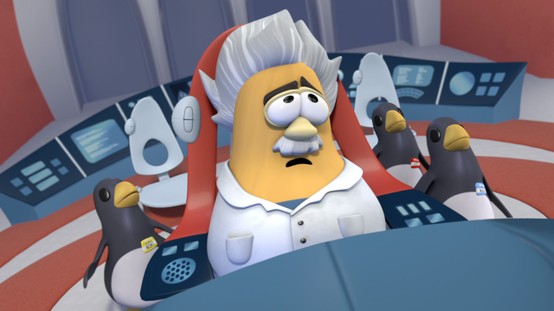
The city of Bumblyburg is in danger once again!  The diabolical Dr. Flurry and his trio of cute little penguin minions are using a device known as the "Fear-Dar" to quite literally freeze Bumblyburg with fear.  Alfred, LarryBoy's brilliant butler, determines that this problem is too much for LarryBoy to handle alone so he calls in the League of Incredible Vegetables, an Avengers-esque team of heroes to assist him.  In addition, the League begins training Jr. Asparagus to be the newest superhero in their team.  But when the League finds themselves in trouble, can Jr. learn how to overcome his fears and look to God for courage?


LONG WINDED NOSTALGIA-FUELED OVER ANALYSIS BELOW.  
(Just skip to the picture of Bob if you want to hear about the actual show itself...)

Now, in the interest of full-disclosure, I feel I should mention that LarryBoy and the Rumor Weed, the second LarryBoy adventure, is my personal favorite VeggieTales episode of all time.  It was funny, exciting, and genuinely cinematic.  However, it was made at a different time in the history of Big Idea, back when Phil Vischer was attempting to push the studio toward creating full length features and really cranking up the production values to new heights.  Like The Fib From Outer Space before it, Rumor Weed also featured a much darker and intense tone than most other VeggieTales episodes.  I was already a bit beyond the target audience for VeggieTales when Rumor Weed was released, so the slightly more "grown-up" style of it was great for me.  The music was intense, the pacing was fast, and the villain was actually slightly intimidating.  That said, it scared the bejeebers out of a lot of little kids.  That Rumor Weed was a pretty creepy looking thing!

Times are a little different now.  Big Idea is a much smaller company than they used to be, and the shows tend be a little smaller in scale, and more overtly kid-oriented than back in ye olden times.  So it comes at no surprise that when Big Idea decided to revisit LarryBoy in 2006 with LarryBoy and the Bad Apple, the tone would be lightened up a great deal.  It's hard to teach nice lessons to kids when they are too scared to watch the show.  Bad Apple was certainly enjoyable, but it didn't come close to the level of excitement that Rumor Weed brought to the table.  And, as expected, The League of Incredible Vegetables continues that trend.  That said, even though The League of Incredible Vegetables is no doubt the most lighthearted of the four LarryBoy adventures, I actually found it to be a better follow-up to the original two episodes than Bad Apple was for several reasons.

First off, a great deal of the "classic" LarryBoy conventions discarded in Bad Apple were revived in this latest installment.  Most significantly?  LarryBoy is once again a rather incompetent hero and not the true focus of the story, with Alfred being the the real brains behind the operation and Jr. Asparagus actually proving to be the main protagonist in the end, just like the original two shows.  Plus, after a detour into Spider-Man territory with Bad Apple, the Batman spoofs that LarryBoy is known for are back in full force, even if the show as a whole obviously takes influence from The Avengers.  The city of Bumblyburg also looks distinctly more reminiscent of the first two episodes as well, though the water tower is still noticeably absent for some reason.  The Larrymobile still doesn't look as cool as the Rumor Weed version, but League more than makes up for it with the super-cool Larry-Copter.

So yeah, for all you LarryBoy fanboys out there, you'll be pleased to know that League actually does a surprisingly good job of recapturing the feel of the first two shows that was strangely absent in Bad Apple.  As a huge fan of Rumor Weed, it is impossible for me to watch League and not still be a bit disappointed that the film doesn't go all out and deliver the same kind of cinematic fun.  But I knew it wouldn't before watching the episode, and I was actually quite pleasantly surprised by how enjoyable League was in its own right.  It seemed a lot more like a classic LarryBoy adventure than I expected it to.

END OF LONG WINDED OVER ANALYSIS.

Okay then.  First, let's talk about the League itself.  Though it does mean that LarryBoy himself is not very prominent in this show, I did enjoy seeing other VeggieTales characters as superheroes.  Bob in particular is highly enjoyable as Thingamabob.  If you really want to get picky and look at the plot as a whole the argument could be made that the League is actually kind of pointless.  Indeed, the story could easily play out almost unchanged with just LarryBoy alone.  The League ultimately does not do much more than get captured.  But the ensemble cast leads to some great moments and it does make the stakes feel higher than they really are.  One could argue that this particular crisis is no bigger than space alien monsters, giant rapidly-growing weeds, or a sneaky temptress apple.  (Okay, maybe that last one.)  But it's still fun to see other Veggie characters getting into the act.

The villain is sort of a mixed bag.  Dr. Flurry is quite entertaining to watch.  He's very goofy and it's hard not to enjoy how slightly scatterbrained his plotting and personality are.  Plus it is SO great to see the penguins from The Toy That Saved Christmas make a return after so long.  They are just as cute and enduring now as they were back in 1996.  Using them as Flurry's minions was an inspired choice and goes a long way toward giving League more of a "classic" VeggieTales feel.

So how about the story and the lesson?  It's pretty solid for the most part.  This is the second time VeggieTales has tackled handling fear, the first being the very first episode Where's God When I'm S-Scared, released way back in 1993.  It definitely makes sense to revisit the theme of looking to God for courage after so many years, and references to the story of David and Goliath are aptly integrated into the story.  It's a good theme to see revisited and the world of LarryBoy is a perfect place to do so.

I must admit, however, that it seems a bit ironic that this is the silliest and most lighthearted LarryBoy episode to date.  For reasons I mentioned above, I understand why League wouldn't be as dark or intense as Rumor Weed or even Bad Apple.  However, it seems a bit odd to do a show about fear when the villain isn't really even the least bit intimidating, especially compared to past LarryBoy villains.  The "greatest fears" of the League members also fall a bit flat, being more comical than actually scary.  (LarryBoy's greatest fear is balloons popping?  Really?)

Fortunately, Jr.'s character arc ensures that the lesson is still clear and well integrated into the story.  Alfred, playing the role of Jr.'s mentor of sorts, is especially entertaining in this episode, even getting to display a fair bit of bravery of his own.  (And make a so-awful-it's-funny "Angry Birds" joke.)

One last thing worth mentioning is that, for the first time, this LarryBoy episode features a silly song.  The song, called "Supper Hero," features Jimmy Gourd as a bumbling "hero" who eats everyone's dinner for them whether they want him to or not.  It's short, not particularly memorable, and not especially funny.  It doesn't really detract from the show as a whole, but I don't think its inclusion was necessary.


Ultimately, The League of Incredible Vegetables proves to be a highly enjoyable LarryBoy adventure.  The adventure is much goofier than past LarryBoy episodes and the plot has a few holes, but the overall lesson is still well presented and the story works for the most part.  It's great to see some other characters get superhero alter-egos and it's also fantastic to see the classic penguins make a return at last.  It doesn't top Rumor Weed as my favorite, but The League of Incredible Vegetables is still a fine addition to the LarryBoy series.  And the theme song (courtesy of the Newsboys) is quite catchy, to boot!

Wednesday, October 17, 2012

Dragons Review: "Dragon Flower"

Trader Johan has come to Berk and brought with him all sorts of exotic goodies for the vikings to purchase.  Soon after his visit, Toothless begins acting very strangely.  It seems as though he's come down with a strange dragon disease and before long all the dragons seem to be feeling under the weather.  They appear to be having a strange allergic reaction to something on the island...

Oh, and Trader Johan traded something suspicious to Mildew at the beginning of the episode when no one was watching.  Hmm...

I'm going to be upfront here:  This episode really annoyed me for the most part.  I like Mildew.  I think he's a highly entertaining antagonist.  But his shtick is getting tedious.  Especially because, once again, his plot was revealed to the audience right off the bat, but then treated as a "mystery" for most of the rest of the episode.  The plot of the dragons getting sick was pretty well done, but I just simply could not enjoy it because I knew it was going to lead to yet another moment where Hiccup confronts Mildew and he denies it despite his obvious guiltiness.  And that's just what happened.  That was a fine story before.  But it's already old and irritating to see repeated again.

The episode's only real saving grace was the ending, which featuring a genuinely thrilling sea battle with a new type of dragon, thought to be able to help cure the other dragons of their disease.  Mildew finally got some long overdue comeuppance and it led to a surprisingly humorous conclusion for the story arc.

Dragon Flower's conclusion shows to me that the team behind Riders of Berk has it in them to make this show great.  But they need to lay off using the same Mildew plot over and over or the show is going to get stale.  Riders of Berk is still going strong at this point, but I'll be curious to see how long it keeps its momentum from here.

Friday, October 12, 2012

Dragons Review: "Portrait of Hiccup As a Buff Man"

This review contains more overt SPOILERS than my reviews normally do.

Portrait of Hiccup As a Buff Man?  That's an odd title!  Believe it or not the name is actually literal.  As it turns out, there is a proud tradition of displaying portraits of the island chief and their son in the Great Hall.  When the portrait of Stoic and Hiccup is unveiled, Hiccup is disappointed to see that he has been portrayed as a muscular young viking, more like how Stoic would prefer him to be remembered.  Oh sure, Hiccup figured out how to tame dragons, but he's just so...small.  Determined to prove to his father that muscles aren't everything, Hiccup sets off on a riddle-laden quest to find a legendary treasure that even Stoic had been unable to find.

Weird title aside, this was another enjoyable episode...for the most part.  I was especially pleased to see that it did not rely on the formula of having two seemingly unrelated plot points that come together in a predictable way at the end, as several past episodes have done.  Instead we got to follow Hiccup and the gang on a treasure hunt.  And it was a pretty clever hunt!

There were just a couple of things about this episode that bugged me though.  The main thing was that all the way through the quest, the treasure hunt appeared to require dragons.  Fire in the ice cave.  Flying up to the serpent rock.  Using both heads of a Zippleback to remove rocks from a wall.  And, of course, wings to survive the long fall at the end.  It's well established that no one trained dragons before Hiccup.  So how would one ever go about hunting for this treasure in the past?

The resolution of the episode tries to clear this up by saying you have to be a "hiccup" to solve the clues and find the treasure.  Evidently a "hiccup" on Berk refers to the runt of the litter.  Seems kind of cruel for Hiccup's parents to name him that then!  So...only spindly little wimpy vikings have the brains to solve the riddles?  Okay, but Hiccup still wouldn't have gotten very far without a dragon or two, plus all his friends, to help out.  It was annoyingly contrived.

Plot holes and story issues aside, this was still a fun episode.  Probably the weakest one so far, but still entertaining.  There were some great set pieces, with the Fireworm dragon scene being particularly well done.  Those story didn't make a lot of sense but, hey, we still got to see Toothless on the screen for a half hour!  I look forward to seeing what Dragons has to offer next.


Wednesday, October 3, 2012

Dragons Review: "How to Pick Your Dragon"

Dragons returns in its new Wednesday night time-slot.  Stoic has decided it's time to embrace the new way of life and wants to learn how to fly on a dragon.  Unsurprisingly, his attempts to fly on Toothless are a bit less than successful at first.  But Hiccup is able to convince his father that having a dragon would make his job as the island chief much easier.  It has unintended consequences, however, as Stoic beings to take Toothless out flying everyday, leaving Hiccup dragon-less.  (And Toothless is none too thrilled to be lugging around a four hundred pound viking all the time either.)  Can Hiccup find Stoic his own dragon that is as good as Toothless?

Oh yeah, and there's a rogue never-before-seen dragon terrorizing Berk.  Where could this story be going, I wonder?

Yeah, this yet another episode of the series to have it's plot be painfully predictable.  But, at the very least, it doesn't really try to hard to hide that fact.  Heck, even the commercial for the episode flat out reveals that Stoic ends up riding on the new dragon.  It's not meant to be much of a reveal.  Instead "How to Pick Your Dragon" focuses on making the story as entertaining as possible, if not especially surprising.  And, despite being predictable, "How to Pick Your Dragon" does tell a unique story that could only be told in the world of Dragons, rather than relying on television cliches like several past episodes.

Admittedly, Hiccup taking his father on a reprise of the "romantic flight" scene from the film (complete with the musical score) comes off a lot goofier than it was likely intended.  But beyond that this is another fairly solid episode, and it was nice to see Stoic's character continue to be fleshed out.  The climax of the episode was also a bit on the silly side, but it was still quite entertaining to watch and had an extremely satisfying conclusion.

These reviews are starting to sound redundant, but honestly there still hasn't been a poor episode of Riders of Berk.  The show's biggest flaw is being predictable, and "How to Pick Your Dragon" is no exception, but the episodes still manage to provide solid enough storytelling and great enough visuals that the predictability of the plot does not get in the way.  Bring on the next episode!

Tuesday, September 25, 2012

Dragons Review: "Alvin and the Outcasts"

This week's episode picks up where "In Dragons We Trust" left off.   Thanks to Mildew's meddling, all the dragons have been banned and sent away to the island they originally came from.  But while Hiccup and the gang are busy looking for evidence of Mildew's plot, a new threat has come to Berk.  Enter Alvin the Treacherous.  He and his ruthless gang of outcast vikings invade and quickly conquer the island demanding to see the legendary "Dragon Conqueror" who resides there.

Though Mildew stepped up to the plate as the main antagonist of the first part of this story, Alvin the Treacherous represents the first full-fledged villain to be introduced to the series, and what a villain he is!  While Mildew has mostly served as a comedic antagonist, there is nothing funny about Alvin.  Though the pacing is quick due to the nature of being a TV show, Alvin is still firmly established as a force to be reckoned with.  The climax of this episodes brings with it some of the fiercest action seen in the franchise as a whole, original movie included.

This episode was not completely devoid of the humor we've seen in the previous episodes, but there was a much larger emphasis on suspense and action this time around.  Plus, my long standing complaint that Stoic the Vast has so little personality in this show is addressed at last, and in a big way.  Stoic is a very prominent character and, at last, he's the powerful viking we saw in the film once again.

"Alvin and the Outcasts" manages to end on a very satisfying note for this two part story but it also sets up some interesting new directions for the series and it actually does not tie up all the loose ends, leaving threads for future episodes to deal with.  Looks like Riders of Berk is as strong as ever.

Tuesday, September 18, 2012

Dragons Review: "In Dragons We Trust"


Mildew is back, as determined to get rid of the dragons as always.  First a dragon crashes through his roof.  Then the dragons steal all of the viking's boots.  Who knows what other havoc the dragons may cause at night?  To keep the mishaps under control, Hiccup goes on night patrol to see what the dragons are up to.  His findings?  Dragons sleep, just like everyone else.  Yet somehow damage continues to appear in the morning that appears to be the work of those pesky dragons, and the incidents continue to become more and more severe.  Could there be some foul play afoot?

At first it seemed this episode would again build it's plot out of common television cliches.  For a portion of the episode, it seemed like a reasonably traditional Scooby-Doo mystery.  But Riders of Berk surprised me again by ending the episode on a rather captivating cliff-hanger and avoids the obvious ending I expected to see play out.  Mildew remains a great new addition to the cast, and he's portrayed in a much more villainous light this time around. Plus Stoic got to display a bit more personality at last.

What at first appeared to be a rehash of the first episode turned out to be the start of what appears to be a multi-episode story arc.  With the fate of the dragons left unknown, I look forward to the next chapter in the story.  Bring on the next episode!

Tuesday, September 11, 2012

Dragons Review: "The Terrible Twos"

The latest episode of Dragons: Riders of Berk finds Hiccup discovering a new type of baby dragon.  The little dragon, named Torch, isn't the friendliest of dragons, and when Hiccup takes the little guy home with him Torch and Toothless do not hit it off.  Hiccup and the gang also quickly discover that Torch has many unique abilities unlike any other dragon, a discovery that really seems to rub Toothless the wrong way.  However, Toothless soon realizes that jealousy may be the least of his troubles when he discovers that Torch's angry mother is rampaging across the island looking for her lost baby.

I was surprised and thrilled to see that "The Terrible Twos" turned out to be such a showcase for Toothless.  He's front and center the whole time!  And not only does Toothless continue to be one of the most appealing characters in the recent history of animation, his ample screen-time also shows off how well produced Riders of Berk is.  Despite being a large and complex character to animate, Toothless moves and emotes beautifully in this episode.  I was also very pleased to see that the creators of the show were willing to have one of the dragons be the main character, instead of merely serving as a sidekick for the human cast.  Here's hoping more episodes put Toothless in charge!

The story relies a bit less on television cartoon cliches than past episodes, even if the jealousy subplot has been seen before, and it easily features the most action-packed moments of the show thus far.  "The Terrible Twos" is yet another in a line of great episodes to start the season.  I can't wait to see what Riders of Berk has to offer next week!

Tuesday, September 4, 2012

Dragons Review: "Animal House"


Cartoon Network's new series Dragons: Riders of Berk officially premiered tonight with what is actually the third episode to air, "Animal House."  Once again the plot was centered around another challenge of living peacefully with Dragons.  This time, it turns out that the farm animals are terrified of the big scaly beasts that suddenly coexist with them.  And, out of sheer terror, the chickens have been rendered unable to lay eggs and the yaks have stopped giving milk.  With a terrible blizzard on the way, it's up to Hiccup (who else?) to figure out how to get the farm animals to relax so the Vikings won't starve during the storm.  But when the blizzard hits early, can Hiccup and the dragons round up the terrified animals before they all freeze to death?

The story isn't going to win any awards.  It's simple and predictable.  The episode beginss with an otherwise unrelated scene about snowboarding on dragons where we learn that dragons have a natural instinct to protect non-dragons in times of peril.  It doesn't take a rocket scientist to put two and two together and figure out where the story is going well before the halfway mark.  It's also a bit strange to see Hiccup so shocked and surprised that Toothless would be willing to save his life given that Toothless kind of did that a whole bunch of times already in the movie.  Plus the whole concept of dragons having a natural instinct to protect all other living creatures is a bit strange.

However, story nitpicks aside, "Animal House" has once again proven to be an enjoyable and well executed extension of the film's world.  The writing continues to be top-notch with lots of great one liners and visual gags that are perfectly in line with the film.  Plus, the tone does a good job of shifting to a more serious side once the blizzard hits.  Stoic continues to lack personality in the show, but all the other characters are spot on.  Toothless gets lots of screen time in this particular episode and he steals the show, as expected.  His animation looks great for a television budget and he even gets to reprise his trademark awkward smile from the film.  The score also does a brilliant job of creating the right tone and atmosphere, with a liberal sprinkling of the movie's themes throughout.

So in the end, even though it's easy to point out how predictable and flawed the story of "Animal House" is, it didn't actually detract from my enjoyment of the episode.  It matches the style and tone of the film perfectly, even if it doesn't offer a lot of surprises.  Plus, it was pretty cool to finally see one of the terrible snow storms mentioned in the film.  And snowboarding on a Night Fury should totally be in the next Winter Olympics.  Dragons: Riders of Berk is off to a good start!